CBSE Class 12 Chemistry: 2022 Supplementary Paper Guide
CBSEChemistry2022 Previous Year Paper
Paper code: 56(B)/6 · 2022Use this solved CBSE Class 12 Chemistry supplementary paper to practise the 2022 Term II format. The guide shows what to look for in the worked solutions, from rate-law assumptions to reagent conditions and electrochemical signs.
This set is one of the year's papers. See every set from 2022, grouped by series.
What this year-wise paper contains
This resource is the full English-language CBSE Class 12 Chemistry supplementary paper for 2022, presented as an adapted paper in the Term II format. The cover identifies it as paper 56/B/6, with a time limit of 2 hours and a maximum of 35 marks. Use those figures to set up a practice attempt for this particular paper, not as a description of the current CBSE exam pattern.
The file pairs the questions with worked solutions, including both printed OR alternatives. The solutions separate the formula, the underlying concept and the explanation in steps. That structure is useful for diagnosing why an answer went wrong: choosing the wrong rule is a different problem from applying the right rule but making a calculation error.

Chemistry Supplementary 2022 | Class 12 | Previous Year Paper | Code 56(B)/6
In the StudentCurio app
A solved CBSE Class 12 Chemistry supplementary examination paper from 2022, in Term II format. It covers questions across topics including chemical kinetics, amines, carbonyl compounds, transition elements, coordination compounds, colloids and electrochemistry.
Chemical kinetics: When the rate equation applies
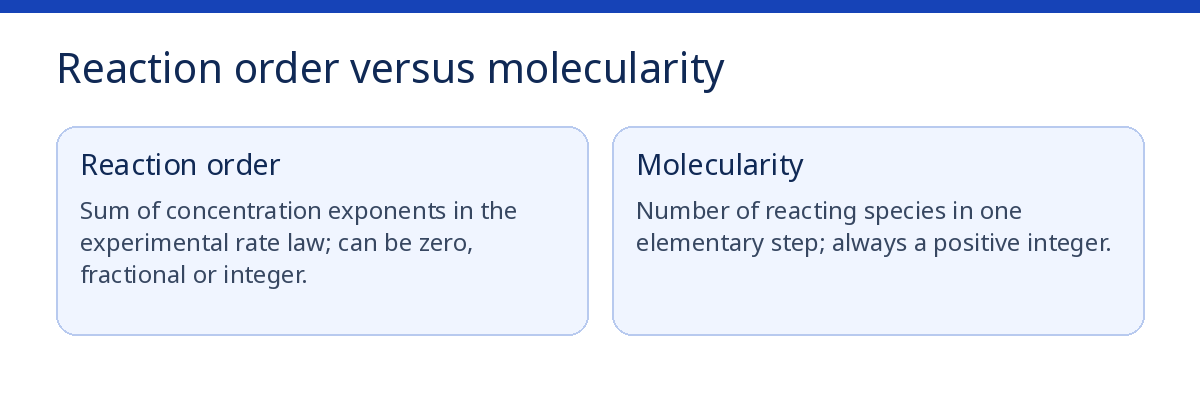
The kinetics questions connect a conceptual distinction with numerical work. Reaction order comes from the experimentally determined rate law: the overall order is the sum of the concentration exponents. Molecularity counts the reacting species in a single elementary step and is a positive integer. Do not infer the order of a multistep reaction from the coefficients of its overall balanced equation, or assign a molecularity to that overall reaction.
In the numerical work, distinguish between a rate law used to compare rates and an integrated law used to relate concentration to elapsed time. The logarithmic concentration–time relation is for first-order behaviour. In a rate table, a reactant with a zero exponent has no effect on the rate within the stated rate law. Check whether the rate constant is expressed per second or per minute before calculating a time.
Organic chemistry: Let the structure and conditions guide you
The organic questions cover amine basicity and identification, named reductions, carbonyl reactions and conversions. For basicity, start by locating the nitrogen lone pair and asking whether it is available to accept a proton or delocalised by resonance. Keep that reasoning separate from water solubility, where hydration and the hydrocarbon portion both matter. This guide omits the worked solubility ranking, which the solution labels an intended textbook comparison.
For conversions, identify the starting functional group, the reagent and the intended stopping point. The paper’s treatment of Clemmensen and Rosenmund reductions illustrates why the label reduction alone does not specify a product: the starting group and conditions differ. For self-aldol reactions, check for an alpha hydrogen before predicting a product. In amine identification, use the structure to explain the observation. For example, when comparing Hinsberg derivatives, ask whether the sulfonamide retains an acidic nitrogen–hydrogen bond rather than simply memorising a solubility pattern.
Transition elements and coordination: Follow the electron count
The inorganic questions use electronic configuration to explain transition-metal properties and the behaviour of coordination compounds. Distinguish the definition of a transition element, which involves an incomplete d subshell in the atom or a common ion, from the explanation of a particular ion’s colour. A filled d subshell does not permit ordinary d–d transitions. For catalysis, look instead for an explanation based on accessible oxidation states or adsorption of reactants.
For a coordination question, determine the metal’s oxidation state before counting its d electrons. Then use the ligand environment to reason about pairing and magnetic behaviour. Keep ligand count separate from coordination number: a bidentate ligand binds through two donor atoms. When writing a salt formula, distinguish ligands inside the coordination sphere from counterions that balance the complex ion’s charge.
Colloids and adsorption: Read pressure and temperature separately
The surface chemistry material asks you to distinguish a multimolecular colloid, described by how its particles form through aggregation, from a sol, described by the phases involved: a solid dispersed in a liquid. Adsorption is a separate idea. It describes accumulation at a surface, not dispersion throughout a liquid.
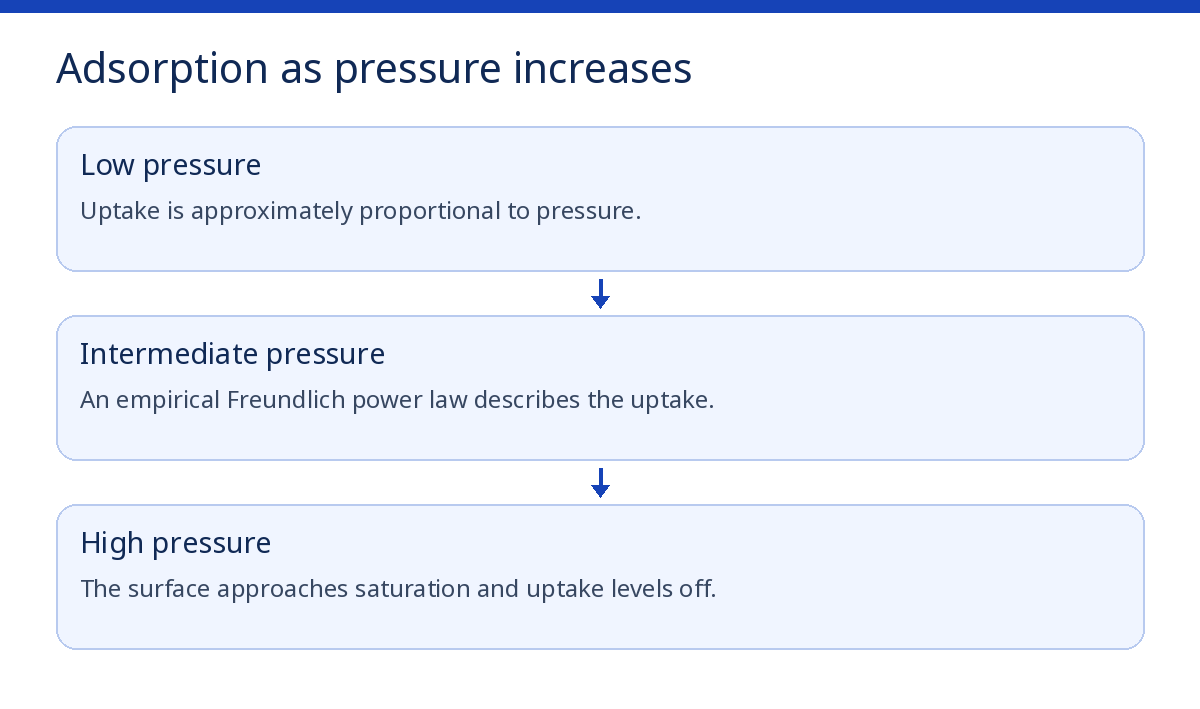
For an adsorption isotherm, interpret the effect of pressure at fixed temperature. The paper distinguishes approximately proportional uptake at low pressure from an approach to saturation at high pressure. The empirical Freundlich power law describes an intermediate range; do not extend it to predict the saturation plateau. When discussing temperature, distinguish equilibrium uptake from the rate of adsorption. Heating generally reduces equilibrium uptake for exothermic adsorption, even though activated chemisorption can initially proceed faster as temperature rises.
Electrochemistry: Check direction, signs and units
The electrochemistry material connects cell notation, reaction direction, conductivity and cell potential. Before applying an equation, identify where oxidation and reduction occur and balance the electron transfer. The electron count used in the free-energy and Nernst relations comes from the balanced cell reaction. Build the reaction quotient from that same reaction so that its powers match the stoichiometric coefficients. The numerical Nernst coefficient shown in the solution is for 25 °C with a base-ten logarithm.
Also distinguish conductivity from molar conductivity. Adding more ions per unit volume can increase conductivity even while molar conductivity decreases as concentration rises. These trends are not contradictory: the two quantities describe different measures of conduction.
Quick self-check after a timed attempt
Attempt the paper before opening the worked solutions. Where an OR choice appears, select one branch for the timed attempt and save the other for a separate round of practice. On review, compare your first reasoning step with the solution’s concept and formula notes before checking the final line.
For each answer you missed, ask which clue in the question should have guided your approach: the concentration dependence, the functional group and reagent conditions, the ligand’s donor atoms, or the direction of electron transfer. Then name one change that would make your original reasoning invalid. That check tests whether you understand when a rule applies, rather than whether you can recognise a familiar answer.
Spotted an error? Report a correction. Practise this in the app: notes, formula sheets and mind maps.















































































































































Loading comments…