CBSE Class 12 Chemistry 2026 Previous Year Paper Guide
CBSEChemistry2026 Previous Year Paper
Paper code: 56/1/2 · 2026Use the full 2026 CBSE Class 12 Chemistry main examination paper for a timed attempt, then use its worked solutions to check your reasoning. This guide explains the paper’s structure and shows what to look for when reviewing physical, inorganic and organic chemistry answers.
This set is one of the year's papers. See every set from 2026, grouped by series.
What the 2026 paper contains
This year-wise resource contains the English version of the 2026 CBSE Class 12 Chemistry main examination, paper code 56/1/2. It is a full paper rather than a chapter-wise collection, so you can practise moving between topics and formats in one sitting. The printed limit is three hours for 70 marks, and calculators are not allowed.
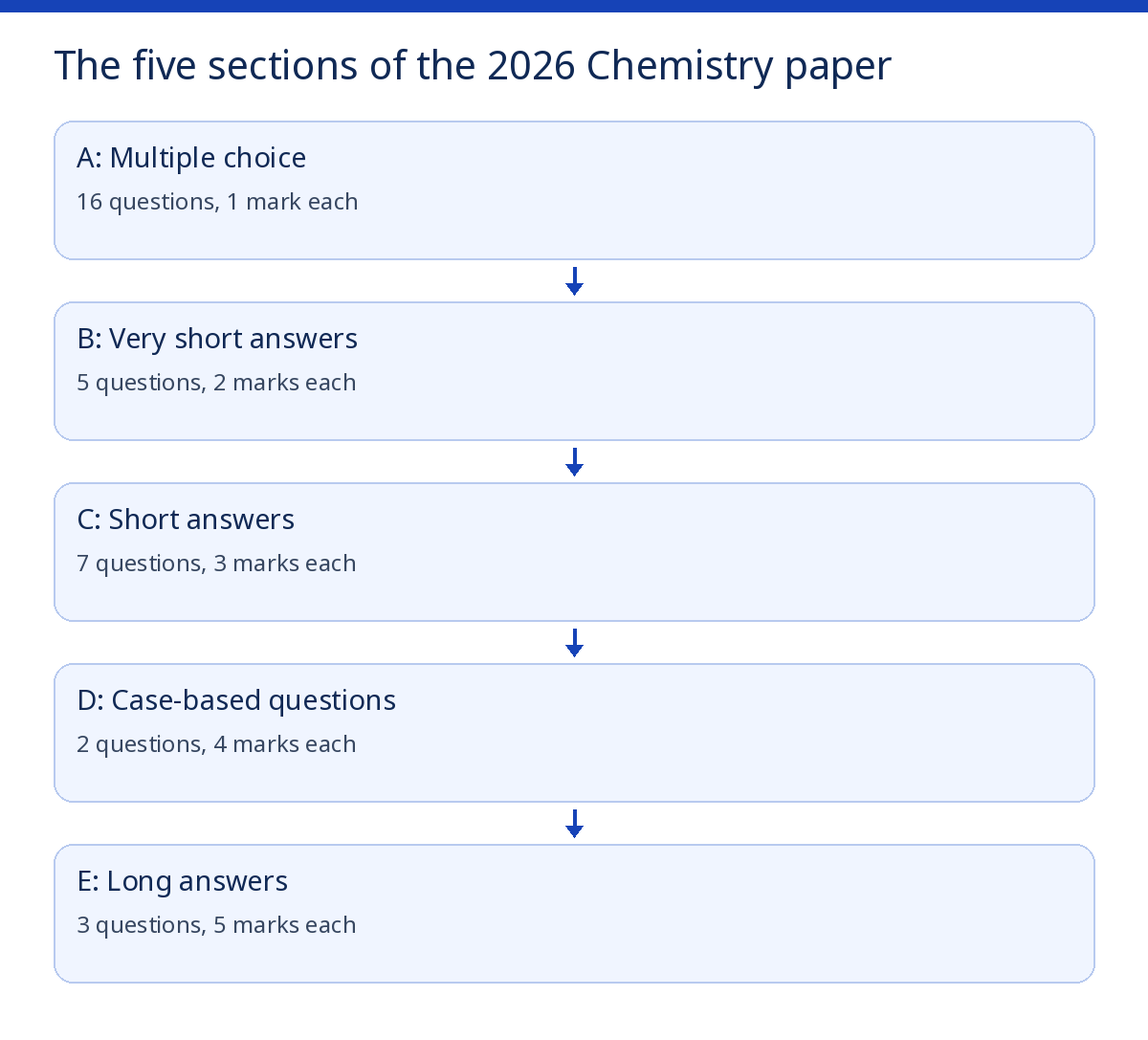
The 33 questions are divided into five sections. Section A has 16 one-mark multiple-choice questions, including assertion–reason items. Section B has five two-mark very short answers, and Section C has seven three-mark short answers. Section D has two four-mark case-based questions, and Section E has three five-mark long answers. There is no overall choice: all question numbers are compulsory, but some questions outside Section A offer an internal choice. When you see an OR, check which part it applies to before deciding what to attempt.

Chemistry 2026 | Class 12 | Previous Year Paper | Code 56/1/2
In the StudentCurio app
A CBSE Class 12 main examination paper with questions across physical, inorganic and organic chemistry, accompanied by worked solutions. Useful for practising board-exam questions and checking solution methods.
Physical chemistry: connect the data to the model
The paper tests chemical kinetics through graphs, reaction rates and a numerical problem set up with total pressure data. In a gas-phase kinetics problem, total pressure and the partial pressure of the reactant are not interchangeable. Before using a rate law, check which quantity the table gives and what the reaction stoichiometry tells you about how that quantity changes. Likewise, do not read reaction orders from the coefficients of an overall equation unless the reaction is specified to occur as a single elementary step.
The solutions questions distinguish Raoult’s law and vapour-pressure behaviour from colligative properties such as osmotic pressure and boiling-point elevation. When solute particles associate or dissociate, the effective particle count can differ from what the stated amount of solute might suggest. In electrochemistry, keep standard cell potential separate from the potential under the conditions given in a problem. As you review a calculation, identify which quantity is supplied, which one the question asks for, and where concentration or pressure enters the reasoning.
Inorganic chemistry: separate the steps in your reasoning
Coordination compounds appear in several formats, from naming and isomerism to a case-based question on geometry, orbital splitting and magnetic behaviour. Keep oxidation state, coordination number and electron arrangement separate. Oxidation state is a formal charge assignment; coordination number counts donor atoms directly attached to the metal, not simply the number of ligand units. Magnetic behaviour depends on whether there are unpaired electrons, so a geometry label alone is not a sufficient explanation.
The paper also asks you to interpret standard electrode potentials for transition metals and to consider permanganate reactions in different media. These tasks require different kinds of evidence: an explanation of an electrode-potential trend should address the values given, while an ionic equation must fit the stated medium and balance both atoms and charge. Do not carry a half-reaction from one medium into another without checking it.
Organic chemistry and biomolecules: make clues do the work
Organic questions ask you to draw structures, explain reactivity, recognise named reactions and plan conversions. When a structure is constrained by several chemical observations, use all the clues. A positive test can suggest a structural feature, but a negative test or a different reaction may rule out a candidate that initially looks plausible. In substitution questions, distinguish kinetic evidence about which concentrations affect the rate from stereochemical evidence about the product. They are related, but they describe different observations.
The amines case study also makes reaction conditions part of the task. Pay attention to when the question specifies an aqueous medium or asks why a group is protected before a reaction. In biomolecules, practise defining closely related terms by the feature that distinguishes them. For a comparison such as nucleoside versus nucleotide, a direct structural distinction is more informative than a general statement about where both are found.
Quick self-check: is the explanation complete?
- In an assertion–reason item, have I judged each statement separately and then checked whether the reason actually explains the assertion? Two true statements do not automatically make an explanation.
- In a case-based subpart, have I used the relevant clue from the passage without simply restating it? The coordination and amines cases ask you to apply the information to specific examples.
- In a multi-part answer, have I given the requested output each time? A structure, a reagent, an ionic equation and a reason are not interchangeable, even when they concern the same reaction.
After the timed attempt: find the first wrong step
Attempt the question paper before opening the worked solutions. During that first sitting, follow the no-calculator rule and choose only the required branch of each internal choice. Save the unattempted branches for review; they let you revisit questions from the same paper without immediately repeating your first attempt.
The solution layout separates the formula used, the concept used and the explanation in steps. Use those labels to locate the first point where your reasoning went off track. If you selected the right formula but substituted the wrong pressure, for example, review what the variables represent rather than memorising the equation again. For structure-based or graphical questions, consult the diagrams in the paper itself. Finally, retry one missed question without the solution open and check whether you can justify the step you previously skipped.
Spotted an error? Report a correction. Practise this in the app: notes, formula sheets and mind maps.















































































































































Loading comments…