CBSE Class 12 Chemistry 2025 Board Paper with Solutions
CBSEChemistry2025 Previous Year Paper
Paper code: 56/1/3 · 2025Practise with the full 2025 CBSE Class 12 Chemistry main board paper, set 56/1/3. Use the original English question layout for a timed attempt, then review the concepts and reasoning behind your answers with the worked solutions.
This set is one of the year's papers. See every set from 2025, grouped by series.
What’s in the 2025 paper file
This year-wise previous paper is the English version of the 2025 CBSE Class 12 Chemistry main examination, with a duration of three hours and a maximum of 70 marks. It is a full board paper, not a chapter-wise worksheet: you have to recognise which branch of chemistry and which concept a question calls for without a chapter heading to guide you.
The file preserves the original question layout, options and diagrams. Its cover links to individual questions and states that the worked solutions cover all subparts and both printed OR alternatives. The explanations distinguish the formula or rule from the concept and the steps that apply it. That structure is useful when a correct answer still leaves you unsure why the method works.

Chemistry 2025 | Class 12 | Previous Year Paper | Code 56/1/3
In the StudentCurio app
The 2025 CBSE Class 12 Chemistry main examination paper with worked solutions, covering questions across organic, inorganic and physical chemistry. Useful for practising the board-paper format and reviewing solution methods.
Physical chemistry: check what the quantity represents
The paper includes standard cell potentials, colligative properties and osmosis. In an electrochemistry calculation, first establish which half-reaction is reduction at the cathode and which is oxidation at the anode. When both tabulated values are written as standard reduction potentials, subtract the anode’s reduction potential from the cathode’s. Coefficients used to balance electron transfer do not multiply the electrode potentials: the amount reacting changes, not the potential.
For colligative properties, separate the amount of solute added from the number of dissolved particles it produces. If solute units associate, fewer independently dissolved particles contribute to the colligative effect. In an osmosis question, identify the direction of solvent movement across the membrane before naming the process. Ordinary osmotic movement does not become reverse osmosis just because water moves out of a cell; reverse osmosis requires applied pressure.
Inorganic chemistry: read the coordination sphere first
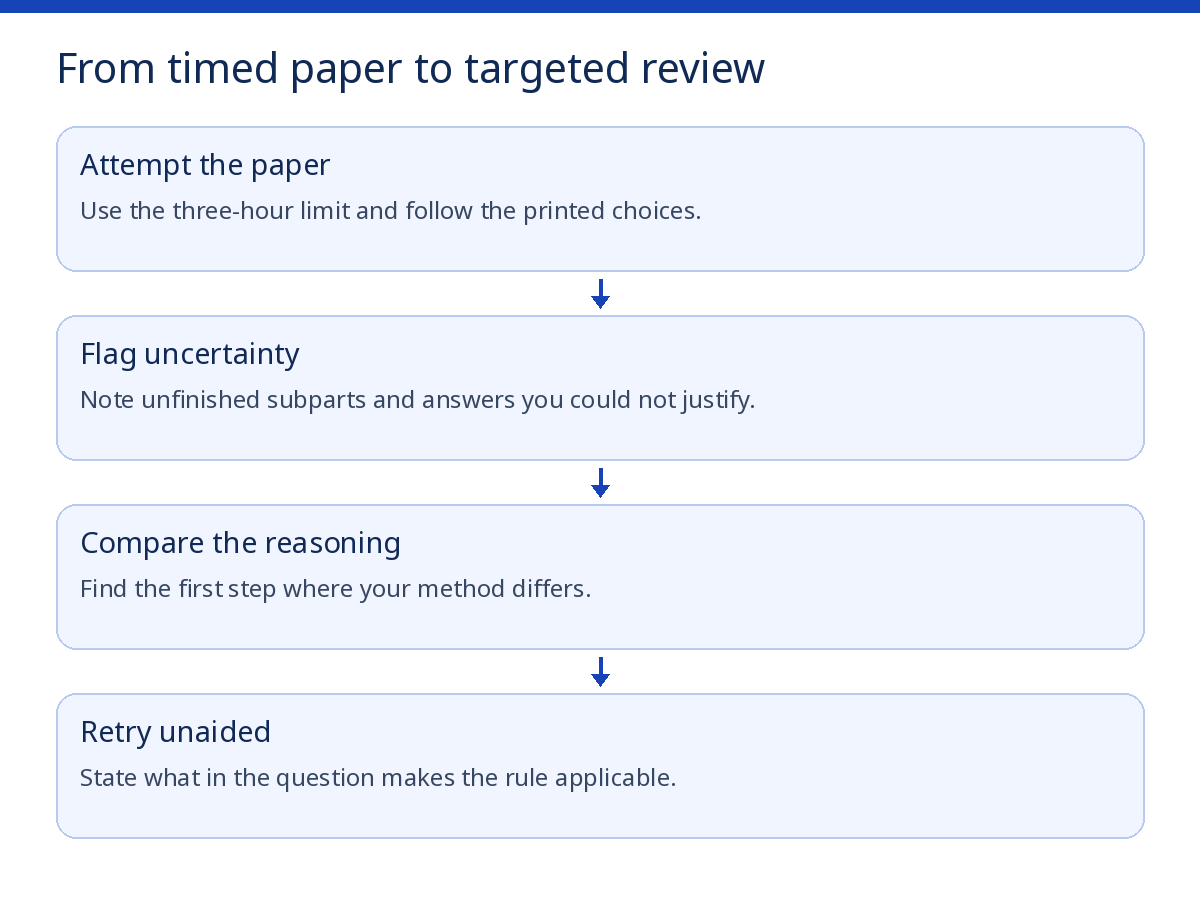
The inorganic questions include coordination nomenclature, oxidation states and magnetic behaviour. Before naming a complex, identify the species inside the square brackets. To find the metal’s oxidation state, add the charges of the coordinated ligands to the unknown metal oxidation state and set the sum equal to the charge on the complex ion. That charge is not necessarily the charge of the compound as a whole.
The brackets also settle a different question: whether the complex is homoleptic. Count the types of coordinated ligand, not the number of ligand molecules, and leave external counterions out of that classification. For the spin-only magnetic moment, a different count matters: determine the number of unpaired electrons for the ion before applying the formula.
Organic chemistry: track the atoms and the reacting centre
The organic questions give you several ways to test reaction reasoning: substitution stereochemistry, Grignard carboxylation, amide transformations and carbonyl reactivity. For a concerted displacement, trace the nucleophile’s approach from the side opposite the leaving group. At a stereogenic reacting centre, the point to explain is inversion of the local arrangement, not just replacement of one group by another.
For a reaction that changes a functional group, count carbons before and after the transformation. In Grignard carboxylation, the additional carbon comes from carbon dioxide. For an amide, direct reduction retains the carbonyl carbon, whereas Hofmann rearrangement does not. Keeping track of that atom distinguishes two routes to amines that can look similar if you focus only on the product’s functional group. For carbonyl addition, consider both the electronic effect of conjugation and how easily a nucleophile can approach the carbonyl carbon.
Common mistakes: overgeneralising a comparison
A boiling-point explanation needs a clearly defined comparison. When comparing branching, keep the molecular formula fixed; when comparing halogens in an alkyl-halide series, keep the alkyl group fixed. Those comparisons isolate different structural changes. Also distinguish intermolecular hydrogen bonding, which occurs between molecules, from intramolecular hydrogen bonding, which occurs within one molecule.
The assertion–reason items make precision especially important. Decide whether each statement is true in the stated comparison before asking whether the reason explains the assertion. A true statement about a related set of compounds is not necessarily the cause of the specific trend being tested. Apply the same care to biomolecules: the predominant cyclic form of a sugar is not a claim that no minor form can exist in equilibrium.
Use the printed choices in a timed attempt
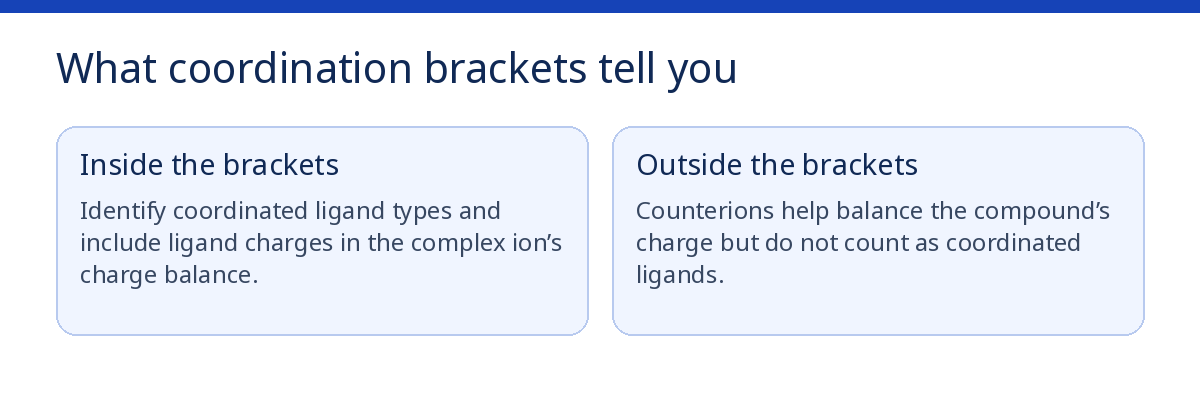
Work from the question-paper portion for the full three hours and keep the solutions closed. Follow the printed instructions for each OR choice rather than doing both alternatives during the timed attempt. Read the diagrams and options in their original layout, and note which subparts you left unfinished or answered without a clear reason. That makes it easier to distinguish running out of time from not knowing how to proceed.
After the attempt, use the question links to review the items you flagged. Try the unused OR alternative separately if you want to test the topic you did not choose under exam conditions.
Quick self-check: find the first step you would change
When you compare your work with a solution, locate the first point at which your reasoning diverged. A wrong electrochemistry result might start with a reversal of the electrode roles rather than a subtraction error. An organic answer might go wrong because you tracked the functional group but lost a carbon atom. Identifying that first step gives you something specific to practise.
Then close the explanation and ask: What detail in the question tells me this rule applies? Retry the question using that detail to justify your method. Do this for uncertain correct answers too, particularly when you selected an option by elimination but could not explain the chemistry directly.
Spotted an error? Report a correction. Practise this in the app: notes, formula sheets and mind maps.















































































































































Loading comments…