CBSE Class 12 Chemistry 2024: Previous Year Paper Guide
CBSEChemistry2024 Previous Year Paper
Paper code: 56/2/1 · 2024Practise the full 2024 CBSE Class 12 Chemistry main examination paper, set 56/2/1, then use the worked solutions to check your method. The paper brings together calculations, reaction reasoning and case-based questions in the original English layout.
This set is one of the year's papers. See every set from 2024, grouped by series.
What the 2024 paper contains
This year-wise file pairs the English version of the 2024 Chemistry theory paper with worked solutions. The paper allows three hours for 70 marks and specifies a separate 15-minute reading period, during which candidates do not write answers. Calculators are not allowed.
The 33 questions are arranged in five sections. Section A has 16 one-mark multiple-choice questions, including four assertion–reason items. Section B has five two-mark very short answers, and Section C has seven three-mark short answers. Section D has two four-mark case-based questions, while Section E has three five-mark long answers. There is no overall choice: the paper requires all numbered questions, subject to the internal choices and subpart instructions printed within them. The worked solutions cover both branches of the printed OR choices, so you can attempt the unused branch during review rather than during your timed sitting.

Chemistry 2024 | Class 12 | Previous Year Paper | Code 56/2/1
In the StudentCurio app
Complete CBSE Class 12 Chemistry main examination paper for 2024, with questions spanning multiple chapters and worked solutions. It helps students practise the full board paper and review their answers, including topics such as conductivity, electrolysis and lead-acid cells.
Physical chemistry: check the assumptions first
The questions on solutions move between vapour pressure, azeotropes and osmotic pressure. Before choosing a relation, identify what the question tells you about the solute and the solution. For an ideal solution with a non-volatile solute, relative lowering of vapour pressure is expressed in terms of mole fraction. If the problem specifies complete dissociation of an electrolyte, the dissolved ions must be included in the particle count. An azeotrope question, by contrast, asks you to reason about departure from ideal behaviour rather than apply the ideal relation unchanged.
In kinetics, distinguish a calculation for a reaction of stated order from one that uses the change in rate constant with temperature to determine activation energy. Use absolute temperatures in the Arrhenius relation. The rate-order item in Question 12 is not used as a worked example in this guide: its elementary-step wording conflicts with the reported concentration–rate behaviour.
Keep conductivity, cell emf and electrolysis separate
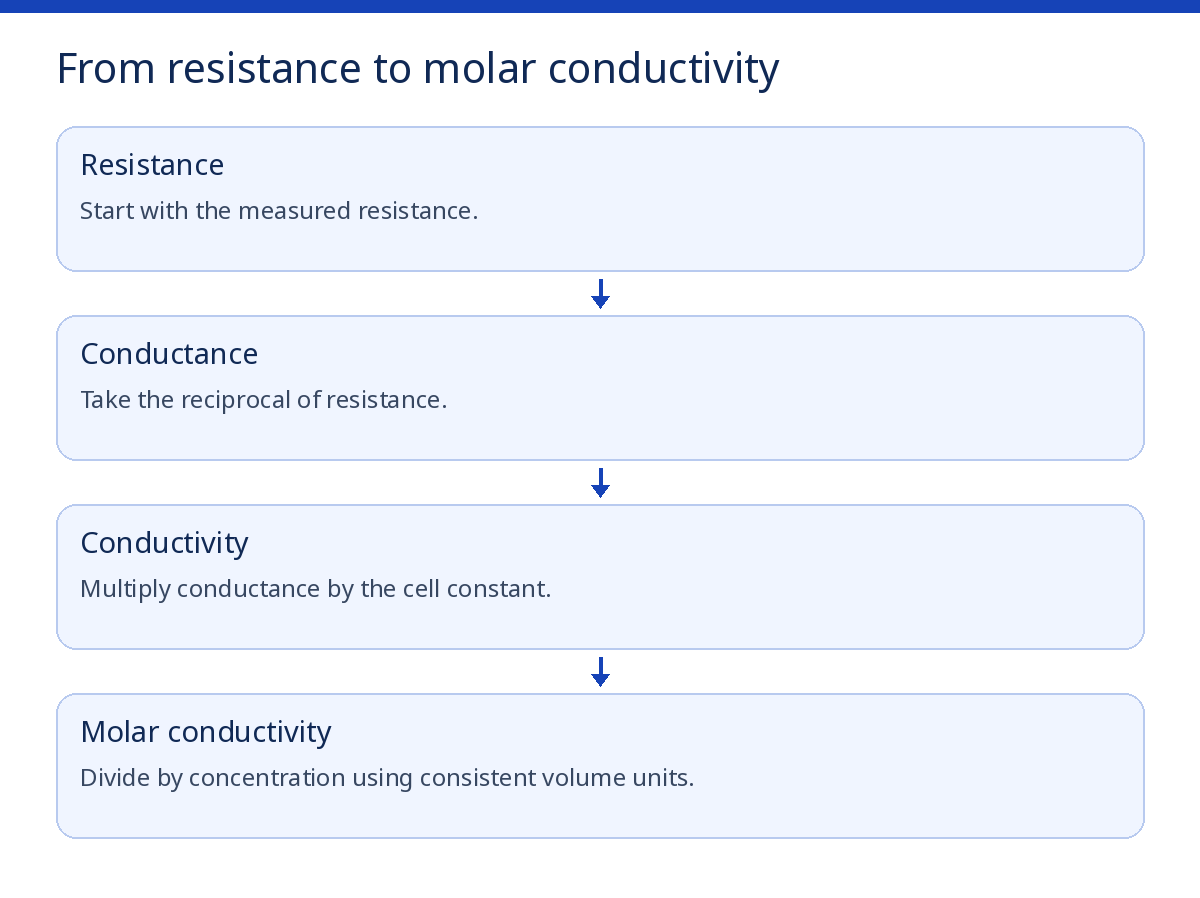
The electrochemistry questions ask for different kinds of reasoning. In a conductivity calculation, resistance gives conductance, and the cell constant converts conductance to conductivity. Molar conductivity then accounts for concentration. If conductivity is in and concentration is in , use to obtain . The acetic acid questions also distinguish molar conductivity at the stated concentration from its limiting value, which is needed when estimating the weak electrolyte’s degree of dissociation.
A cell emf calculation instead requires the balanced cell reaction, the corresponding electron count and a reaction quotient consistent with that reaction. In electrolysis, check whether the medium is aqueous before deciding which species can react at an electrode. For the lead storage battery prompt, write the two electrode reactions separately and check that electrons cancel when you combine them into the overall reaction.
Organic chemistry: let the prompt determine the answer
The organic questions ask for more than product recall. Reaction sequences require you to identify intermediates; preparation questions call for equations; and distinguishing tests call for observations that let you tell two compounds apart. In a sequence, carry the structure you have drawn into the next step and check which functional group the new reagent acts on. For a test, naming the reagent is less useful than stating what you would observe with each compound.
The paper also asks for explanations about substitution, aromatic directing effects and optical activity. Keep reactivity separate from orientation: an explanation of where substitution occurs on an aromatic ring is not automatically an explanation of how fast the ring reacts. When comparing substitution reactions, identify the reacting carbon and examine its surroundings rather than classifying the whole molecule from a nearby double bond.
Quick self-check: which coordination model fits?
The coordination chemistry questions range from ligand denticity and chelation to naming, isomerism, geometry and magnetic behaviour. Some prompts specify valence bond theory; others explicitly ask for crystal field reasoning. In the latter, the comparison between splitting energy and pairing energy governs how electrons occupy the split orbitals. Do not infer the spin state from the metal’s electron count alone.
Before you check the solutions, ask yourself: can I separate the number of donor atoms a ligand uses from the number of ligands present? Can I identify which model the question requests before I write about geometry, orbital occupancy or unpaired electrons? These checks help you diagnose whether an error came from reading the formula or applying the model.
Use the two case passages as evidence
The case-based section pairs carbohydrates with transition metals. In the carbohydrate passage, separate classification by hydrolysis from evidence about glucose structure. Those are different tasks: one concerns what a carbohydrate yields on hydrolysis, while the other uses chemical behaviour to reason about functional groups and cyclic forms.
The transition-metal passage combines characteristic properties with a table of standard electrode potentials. Distinguish a question that asks you to interpret a trend from one that asks you to explain an electronic property. For both cases, mark which information the passage supplies and which principle you must bring to the answer.
Review the first step that went wrong
After a timed attempt, use the question-number links to move between the paper and its worked solutions. Compare your answer with the formula used, concept used and explanation in steps, rather than checking only the final result. If a calculation differs, locate the first point of departure: the chosen relation, a unit conversion, the sign, or the arithmetic. For assertion–reason items, check the truth of each statement before asking whether the reason actually explains the assertion. Then try an unused OR branch to see whether you can apply the same checking process without following a solution you have already read.
Spotted an error? Report a correction. Practise this in the app: notes, formula sheets and mind maps.















































































































































Loading comments…