2023 CBSE Class 12 Chemistry Paper With Worked Solutions
CBSEChemistry2023 Previous Year Paper
Paper code: 56/4/1 · 2023Practise the full 2023 CBSE Class 12 Chemistry main examination paper, Set 1 (56/4/1), under its three-hour writing limit. Then use the worked solutions to check how you chose a method, handled the data and explained your reasoning.
This set is one of the year's papers. See every set from 2023, grouped by series.
How the 70-mark theory paper is organised
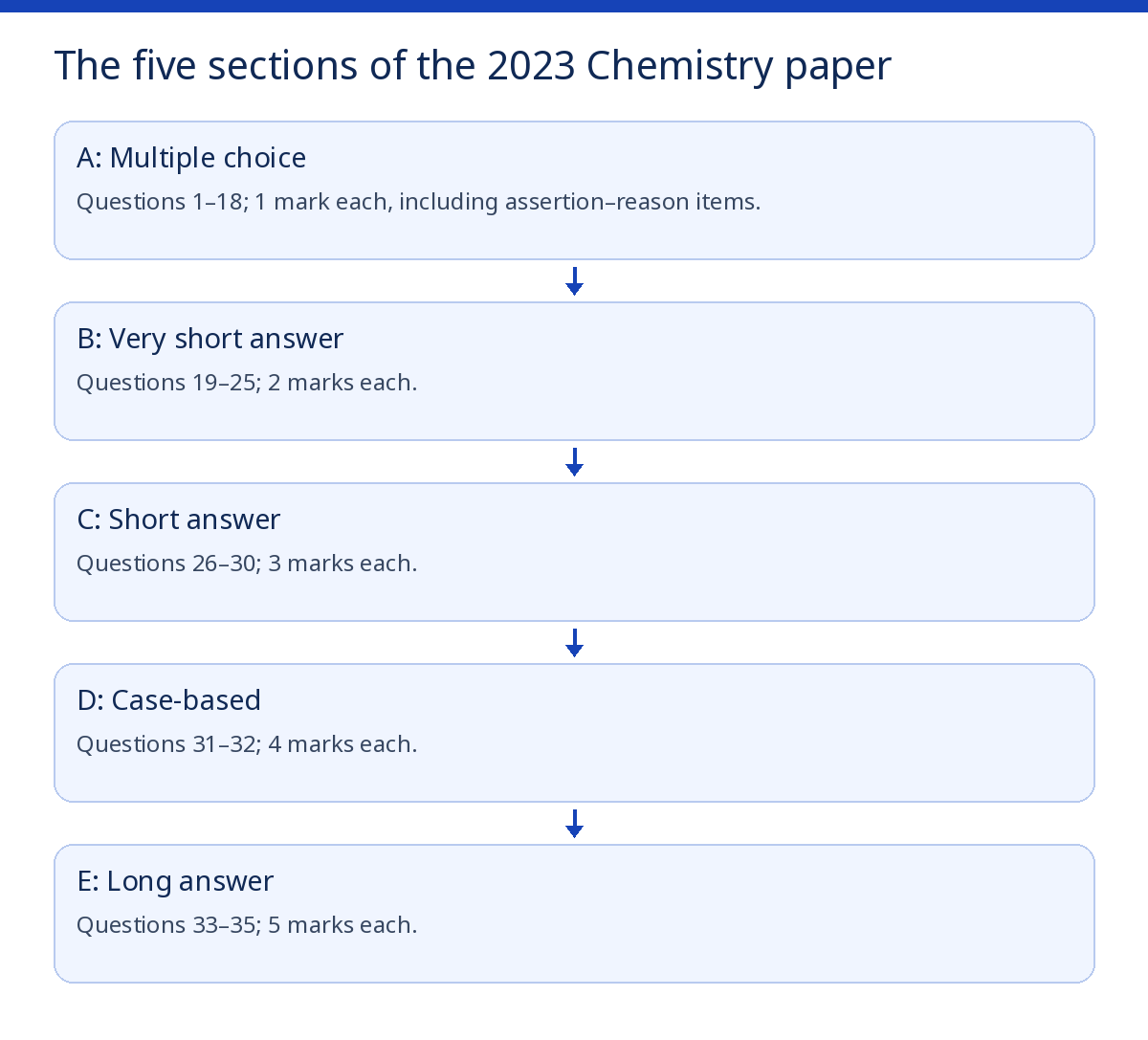
This year-wise resource brings together the English question paper and worked solutions for one complete CBSE board exam. Section A contains 18 one-mark multiple-choice questions, including four assertion–reason items. Section B has seven two-mark very short answers, and Section C has five three-mark short answers. Section D contains two four-mark case-based questions, while Section E has three five-mark long answers.
The paper has 35 compulsory questions and no overall choice. Internal choices appear in Sections B through E, so follow the instructions at the relevant question or subpart rather than attempting every alternative. For a realistic sitting, allow the printed 15-minute reading period before the three hours of writing, keep the solutions closed and work without a calculator.

Chemistry 2023 | Class 12 | Previous Year Paper | Code 56/4/1
In the StudentCurio app
The complete 2023 CBSE Class 12 Chemistry main examination paper with worked solutions, covering questions across multiple Chemistry chapters. Helps students practise board-style questions and review solution methods.
Solutions and kinetics: identify what the data represent
The paper tests solutions through solute association, colligative properties and deviations from Raoult’s law. The key distinction in association problems is between the amount of solute added and the number of particles it contributes after dissolving. When molecules join together, those quantities are no longer interchangeable. For a question about a liquid mixture instead, identify which behaviour is being compared with that of an ideal solution before deciding how to explain the deviation.
In chemical kinetics, the paper moves between reaction order, half-life, activation energy and pressure data. Identify the reaction order before choosing an integrated rate law. In a gas-phase decomposition that produces more than one gaseous product, total pressure includes contributions from products as well as unreacted reactant. Use the reaction stoichiometry to relate the measured pressure to the species whose amount the rate law tracks.
Common mix-ups in electrochemistry
Electrochemistry appears in several forms, from identifying cells by their uses to interpreting conductivity and calculating potentials. Match the approach to the quantity requested:
- Conductivity and molar conductivity are different quantities. Check the concentration units before converting between them. For a weak electrolyte, dilution changes the proportion of solute that dissociates, so do not automatically apply the same extrapolation to limiting molar conductivity that you would use for a strong electrolyte.
- Standard potential is not necessarily the potential under the stated conditions. For potential calculations with specified concentrations, identify whether the question gives a single half-reaction or a complete cell. When setting up the Nernst equation for a complete cell, balance the net reaction first so that the reaction quotient and electron count refer to the same reaction.
Coordination compounds: separate charge, shape and magnetism
The inorganic questions ask for names, oxidation states, isomers and explanations of magnetic behaviour. Start by separating the species inside the coordination brackets from any counterions outside them. The charges of the ligands and the overall charge of the coordination entity are what you need to determine the metal’s oxidation state. The brackets also help you distinguish a change in what is bonded to the metal from a change in how the bonded groups are arranged in space.
Geometry and magnetism require different checks. A shape describes the arrangement around the metal, whereas paramagnetism depends on whether unpaired electrons are present. For the transition-element questions, pay attention to the particular ion and its oxidation state rather than relying on the properties of the neutral atom alone.
Organic chemistry: let the conditions guide the method
The organic questions range from choosing a likely product to writing a mechanism, planning a conversion and distinguishing compounds by a chemical test. Before writing, identify the starting functional group and read the full set of conditions. A reagent name alone may not settle the outcome: the substrate, solvent, heating and whether a reagent is in excess can affect what reaction occurs or how far it proceeds.
Match the detail of your response to the instruction. A product question asks where the reaction ends; a mechanism asks how it gets there. For a conversion with a stated step limit, check each intermediate against the target and count the steps. For a chemical test, practise writing the distinguishing observation as well as naming the reagent.
Case-based questions: connect the passage to each subpart
The two case-based questions focus on biomolecules and amines. In the biomolecules case, the passage moves from carbohydrate classification and linkages to levels of protein structure. Identify whether a subpart is asking about a bond between building units or about the organisation of a protein; those prompts call for different kinds of explanations.
The amines case connects structure to basicity and reactivity. In a basicity comparison, note the solvent specified: the passage points to several competing effects on the stability of substituted ammonium ions in a polar protic solvent, so an argument based only on electron donation can miss part of the comparison. Use the passage to identify the relevant idea, then answer the specific subpart rather than summarising the case.
Quick self-check after using the worked solutions
Open the solution for a question only after committing to your own attempt. The file’s solution format separates the formula or relationship, the concept and the steps. Compare those layers in order: did you pick a suitable method, apply it under the right conditions and carry it through correctly? For assertion–reason items, check the truth of each statement separately before judging whether the reason actually explains the assertion.
On a second pass, try an internal alternative you skipped in the timed sitting. This lets you review content that your first attempt did not test. This guide omits individual answer options and worked examples, including items whose structures, signs or units are incomplete in the text extract; consult the PDF page for the printed notation.
Spotted an error? Report a correction. Practise this in the app: notes, formula sheets and mind maps.















































































































































Loading comments…