CBSE Class 12 Chemistry 2022 Previous Year Paper
CBSEChemistry2022 Previous Year Paper
Paper code: 56/2/3 · 2022Practise the full CBSE Class 12 Chemistry 2022 main examination paper (56/2/3) in its original Term II format. Use the worked solutions after your attempt to check how you chose formulas, interpreted reaction conditions and justified your answers.
This set is one of the year's papers. See every set from 2022, grouped by series.
Know the 2022 Term II paper format
This year-wise file contains the English version of the 2022 Chemistry theory paper. It allows two hours for 35 marks, with a separate 15-minute reading period during which candidates were not to write answers. Calculators and log tables were not allowed. Use these conditions if you want to recreate this particular sitting rather than assume its format applies to a current board paper.
Section A has three very short-answer questions worth two marks each. Section B has eight short-answer questions worth three marks each. Section C has one five-mark case-based question on amines. The instructions make all 12 numbered questions compulsory, but some contain internal choices. In a timed attempt, follow the printed choice instructions; in review, try the unused alternatives to see whether you can handle the same topic in a different form.

Chemistry 2022 | Class 12 | Previous Year Paper | Code 56/2/3
In the StudentCurio app
Complete CBSE Class 12 Chemistry main examination paper for 2022, with worked solutions for its questions and printed alternatives. It covers organic chemistry, electrochemistry, chemical kinetics, coordination compounds, transition elements and other topics, helping students practise and review board-exam questions.
Organic chemistry: read the reagent and the work-up
The organic questions ask for products, comparisons and explanations. The carbonyl and carboxylic acid material includes Grignard reactions, controlled reduction, carbonyl derivatives, acidity and reactivity towards HCN. Other prompts ask you to explain a difference in oxidation behaviour or distinguish compounds with a chemical test. A product prediction and a distinguishing test call for different answers: one identifies what forms; the other needs an observation that separates the two compounds.
Good to remember: Read the full reaction arrow, including any treatment after the initial reagent. An acidic work-up can protonate the intermediate, so that intermediate is not necessarily the final product requested. When a question asks for an increasing order, first identify the property being compared. The factors that influence addition to a carbonyl group, such as crowding and electron donation, are not the same as the factors you weigh when comparing acid strength.
Electrochemistry: separate conductivity from cell emf
One problem connects measured resistance to the cell constant and then uses conductivity and concentration to find molar conductivity. Keep the two steps distinct: gives the cell constant in inverse centimetres when conductivity is in siemens per centimetre and resistance is in ohms. The expression gives molar conductivity in siemens square centimetres per mole when conductivity is in siemens per centimetre and concentration is in moles per litre.
The emf problem tests a different chain of reasoning. Balance the overall redox reaction before writing the reaction quotient or deciding how many electrons are transferred. The worked solution notes that it assumes 298 K because the question does not state a temperature. The decimal coefficient in that version of the Nernst equation depends on this assumption. This guide omits the numerical emf and the extracted electrode-potential values; read the signs and notation on the PDF page itself.
Kinetics: distinguish a rate change from a time calculation
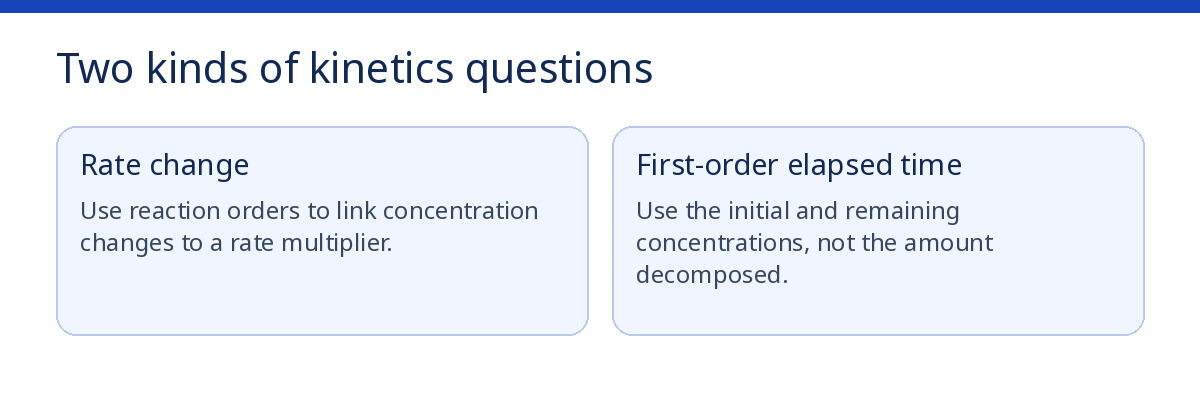
The paper tests kinetics in two ways. A rate-law question asks what happens when reactant concentrations change. At constant rate constant, the multiplier for each concentration is raised to that reactant’s order; if more than one concentration changes, multiply the resulting factors. An unchanged concentration contributes no change to the rate ratio.
The first-order decomposition question instead asks you to connect elapsed time with the amount of reactant remaining. The integrated first-order expression uses the ratio of initial to remaining concentration, not the ratio of initial concentration to the amount decomposed. Quick self-check: Before doing arithmetic, can you say whether the question is about the rate at a new set of concentrations or the time needed to reach a given extent of decomposition? That distinction tells you which relationship to use.
Inorganic and surface chemistry: build the reason
For coordination compounds, the paper moves between naming, ligand behaviour, hybridisation and magnetism. When reasoning about magnetism, work from the metal oxidation state and electron count to pairing and then to the presence or absence of unpaired electrons. In ligand questions, distinguish the donor atoms available from the number that bind at once: an ambidentate ligand offers alternative donor atoms, while a bidentate ligand binds through two donor atoms simultaneously.
The transition-element questions ask for explanations involving catalysis, electronic configuration, atomic radii and standard reduction potentials. In explaining trends in those potentials, do not rely on a single periodic trend: atomisation, ionisation and hydration all contribute. The surface chemistry alternatives use a different kind of comparison. For lyophilic and lyophobic sols, compare both on the same basis, such as affinity for the dispersion medium or resistance to coagulation by an added electrolyte.
Use the amines passage and the worked solutions
The case-based section links amine basicity, identification tests and reaction sequences. Use the passage to identify the relevant idea, then answer the particular prompt rather than paraphrasing the passage. For a basicity comparison, check whether the requested order is by base strength or by : in the same medium and at the same temperature, a lower corresponds to a stronger base. For a conversion, track the functional group after each step before moving to the next reagent.
After your attempt, use the question-number links to compare your reasoning with the worked explanations. For a calculation, find the first step where your setup differs before checking arithmetic. For a written explanation, check whether you connected the observation or trend to its chemical cause. Then try an unused OR branch without looking at its solution: it may ask you to explain or compare where your first choice asked you to predict.
Spotted an error? Report a correction. Practise this in the app: notes, formula sheets and mind maps.















































































































































Loading comments…