CBSE Class 12 Applications of Derivatives: Case-Based Practice
CBSEMathematicsApplications of Derivatives
This CBSE Class 12 Mathematics assessment uses plant growth, pricing and geometric design to practise rates of change and optimisation. Its linked solutions let you check how each model is built, not just whether your final answer matches.
What the assessment covers
The file contains 32 case studies and 146 subquestions, including OR alternatives. Cases 1–4 and 13–32 are multiple-choice, while Cases 5–12 are short-answer. The questions come first, followed by step-by-step solutions in the same case order. The clickable index lets you open either the questions or the solutions for a case, and each subquestion has a direct solution link.
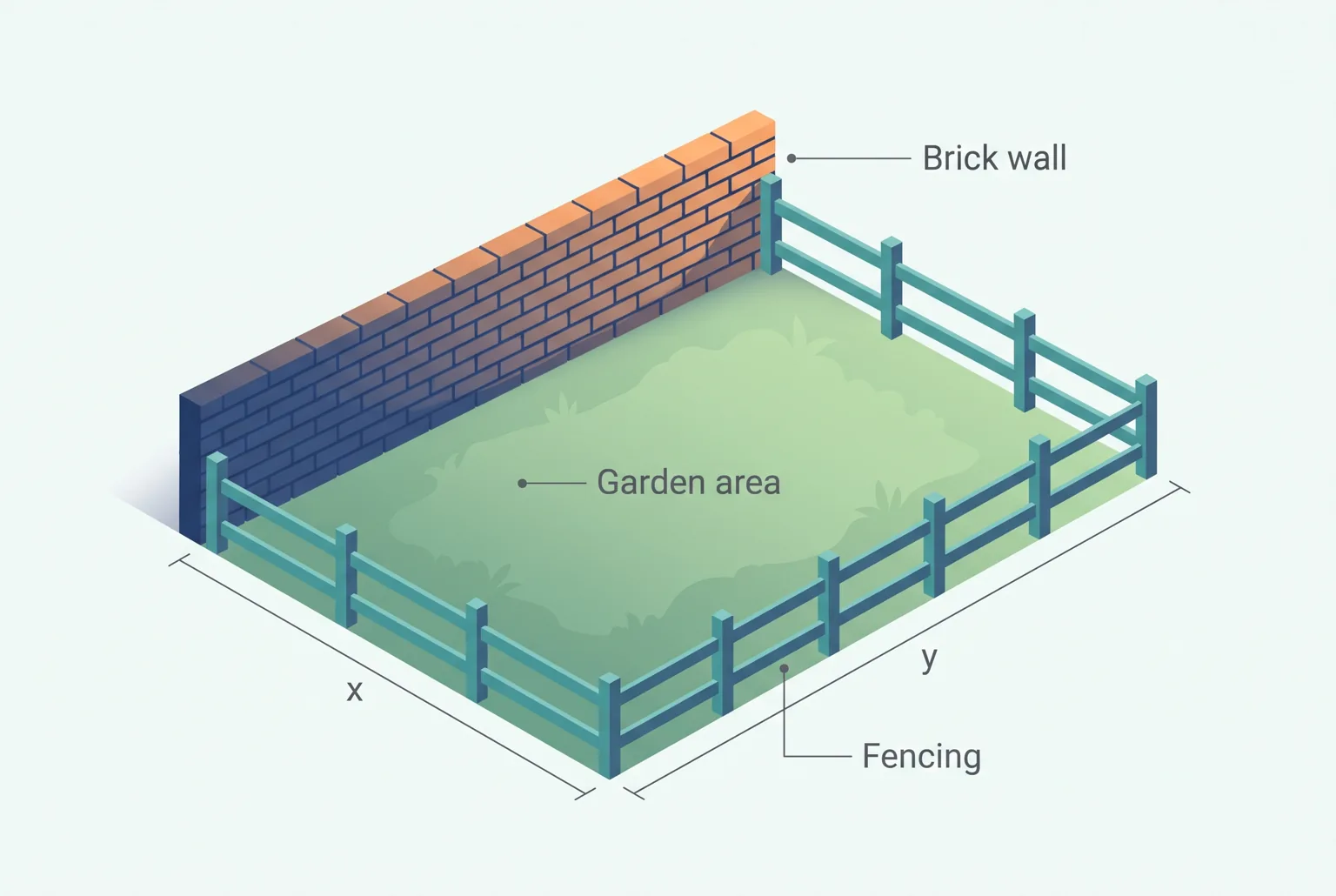
The cases require different starting points. The plant growth and company profit cases give you a function to interpret or analyse. In cases such as the fenced garden and open irrigation tank, you first have to turn a description into a function. This distinction matters: a correct derivative cannot fix an objective that describes the wrong area, cost or quantity.

Applications of Derivatives | Class 12 | Case-based Assessment
In the StudentCurio app
Case-based questions with solutions apply derivatives to rates of change and real-world optimisation, including maximising area, revenue and profit and minimising material or construction costs. Helps Class 12 students practise contextual applications of derivatives.
Rates of change: distinguish a value from its rate
In the plant growth case, height is measured in centimetres and exposure time in days. The height function gives a value in centimetres; its first derivative gives the instantaneous growth rate in centimetres per day. The second derivative describes how that rate changes, in centimetres per day squared. Keep those three quantities separate when a subquestion asks whether the plant’s growth rate is increasing or decreasing.
A decreasing growth rate does not by itself mean that height is decreasing. While the first derivative stays positive, the plant is still getting taller in the model, even if the rate is falling. Use the stated time range when interpreting the result rather than extending the model beyond the period described.
What a derivative sign chart can tell you
The increasing and decreasing functions case states the sign rules with their hypotheses: if is continuous on and differentiable on , then throughout gives strict increase on , and throughout gives strict decrease. If throughout , the function is constant on . These are sufficient conditions; a zero derivative at a single point does not make a function constant on an interval.
In the toy-shape case, the polynomial gives you a way to practise dividing the domain at critical points and checking the sign on either side. More generally, check the domain before making the chart: a point where the derivative is undefined can be an interior candidate only if the function itself is defined there.
A useful comparison: what counts in the constraint?
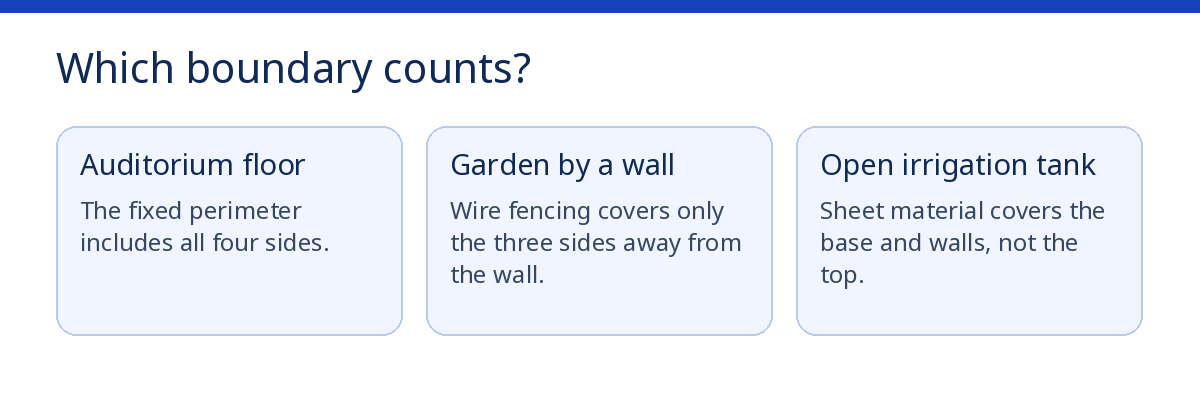
Compare the rectangular auditorium floor with the garden beside a brick wall. Both cases aim to maximise rectangular area, but the auditorium has a fixed perimeter around all four sides, while only three sides of the garden require fencing. The objective is the same kind of quantity; the relationship between the dimensions is not. If your model counts a side that uses no fencing, the error carries through every later step.
The open irrigation tank makes a related distinction. Its capacity sets the volume constraint, but the sheet material covers the base and walls, not a lid. With a fixed positive price per square metre, minimising the sheet area also minimises material cost. When using dimensions in metres, express the capacity in cubic metres before combining it with those dimensions.
Before you differentiate: define the feasible inputs
The handmade gift box case shows why a formula’s algebraic domain is not necessarily the domain of the problem. A corner cut must leave both a positive height and a positive base length. A value that makes a dimension zero may describe a limiting shape, but it does not produce a usable box.
The same distinction applies to commercial models. The electric bike case assigns its linear rental model a stated price interval and describes what happens outside that interval separately. Do not extend the linear expression just because you can substitute a price into it. In the company profit case, the solution also distinguishes the polynomial’s real domain from nonnegative production and distinguishes continuous optimisation from choosing a whole number of units.
When a local result is not the final answer
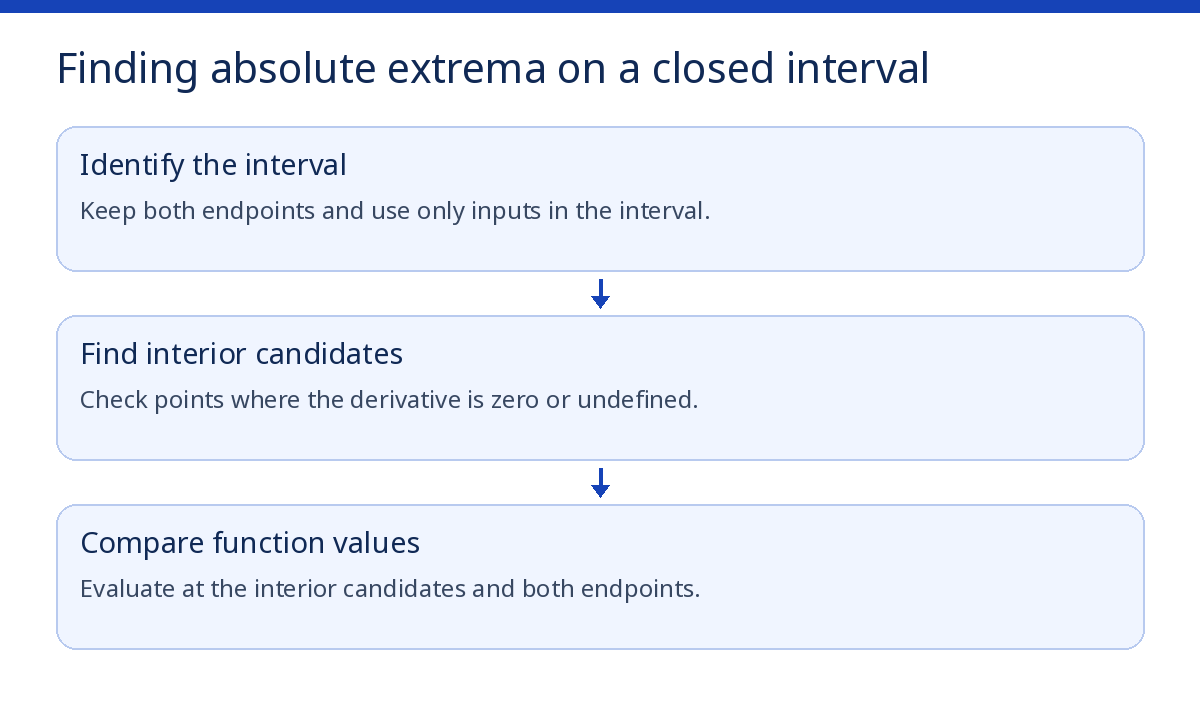
An interior point where is a candidate, not a verdict. A change in the derivative from positive to negative gives a local maximum; the reverse gives a local minimum. At an interior stationary point where the second derivative exists, a negative second derivative gives a local maximum and a positive one gives a local minimum. A zero second derivative leaves that test inconclusive.
The illness temperature case separates local extrema in an open interval from absolute extrema on a closed interval. For a continuous function on a closed bounded interval, compare its values at the endpoints and at eligible interior critical points. A local test describes behaviour nearby; it does not compare the candidate with every other feasible input.
Use the linked solutions to find the first wrong step
Try a case before opening its solution. For a modelling question, write down the input, the quantity to optimise and the constraint before looking at the options. Then use the linked solution to locate the first place your reasoning diverged: the setup, the feasible interval, the differentiation or the interpretation. The return link lets you go straight back to the next subquestion.
For a comparison of methods, try the elliptical soccer field case using the first derivative test and then use its OR alternative to check the same candidate with the second derivative test. This guide leaves out Case 3 Q2 and the disputed attendance and price datum in Case 18; neither is needed to practise the underlying methods.
Spotted an error? Report a correction. Practise this in the app: notes, formula sheets and mind maps.





























































































































































Loading comments…