Amines: CBSE Class 12 PYQs with Solutions and Key Ideas
CBSEChemistryAmines
This guide to the CBSE Class 12 Chemistry Amines PYQ collection explains the ideas its questions return to: basicity and pKb trends, preparation routes, Hinsberg, carbylamine and nitrous acid tests, and the protection of aniline. It also covers diazonium stability and coupling, and suggests how to practise the MCQ, assertion-reason, case-based and subjective sections.
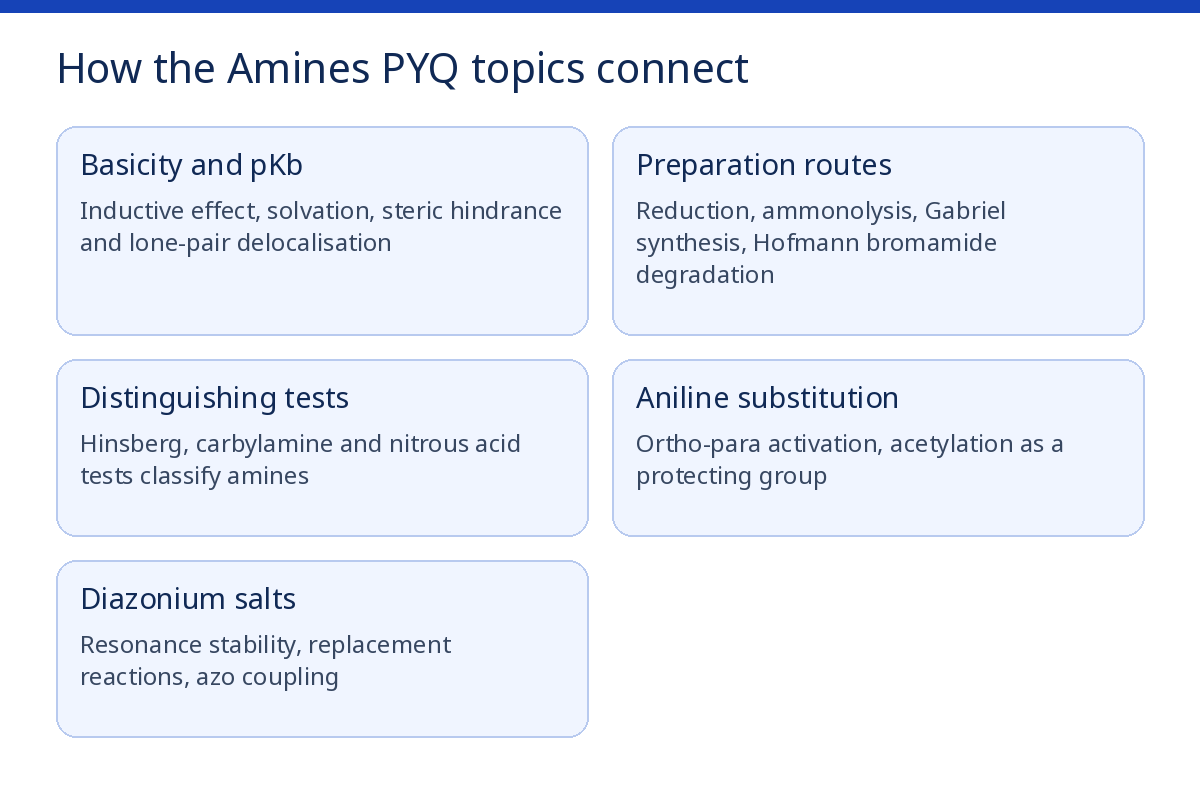
How the Amines PYQs are organised
The collection is for Chapter 9: Amines in the current CBSE Class 12 sequence. Older NCERT editions number this chapter 13. The PDF carries exam-year labels from 2022 to 2026 and prints 167 questions, each with an added worked solution.
The questions keep their original serial order:
- Q1–Q106 are single-answer items. These are 72 MCQs and 34 assertion-reason questions.
- Q107–Q167 are written questions. These are 54 subjective and 7 case-based questions.
A topic finder groups the questions under eight headings. The heaviest lists are for:
- basicity
- preparation
- reactions of aliphatic amines
- diazonium salts
- distinguishing tests
The source material had answer-key entries but no full written solutions, so every solution is labelled Added solution. Apparent errors in the source questions are kept as printed and explained in the solutions.

Amines | Class 12 | Previous Year Paper
In the StudentCurio app
A comprehensive 170-page collection of solved previous year questions for CBSE Class 12 Chemistry chapter Amines. It covers key topics like basicity trends, named reactions, and chemical identification tests with detailed solutions.
Ranking basicity and reading pKb values
Many items ask you to order amines by basic strength or by pKb. Since , a lower pKb means a stronger base. Reversing this is the most common slip.
Three effects decide aliphatic basicity in water:
- Inductive (+I) effect: alkyl groups push electron density onto nitrogen.
- Solvation: water stabilises the protonated amine through hydrogen bonding, and this is stronger when more N–H bonds are present.
- Steric hindrance: bulky groups crowd the nitrogen and hinder that solvation.
These effects balance differently for methyl and ethyl amines, so the aqueous order is not the same for the two series. Reason it out each time rather than memorising one pattern.
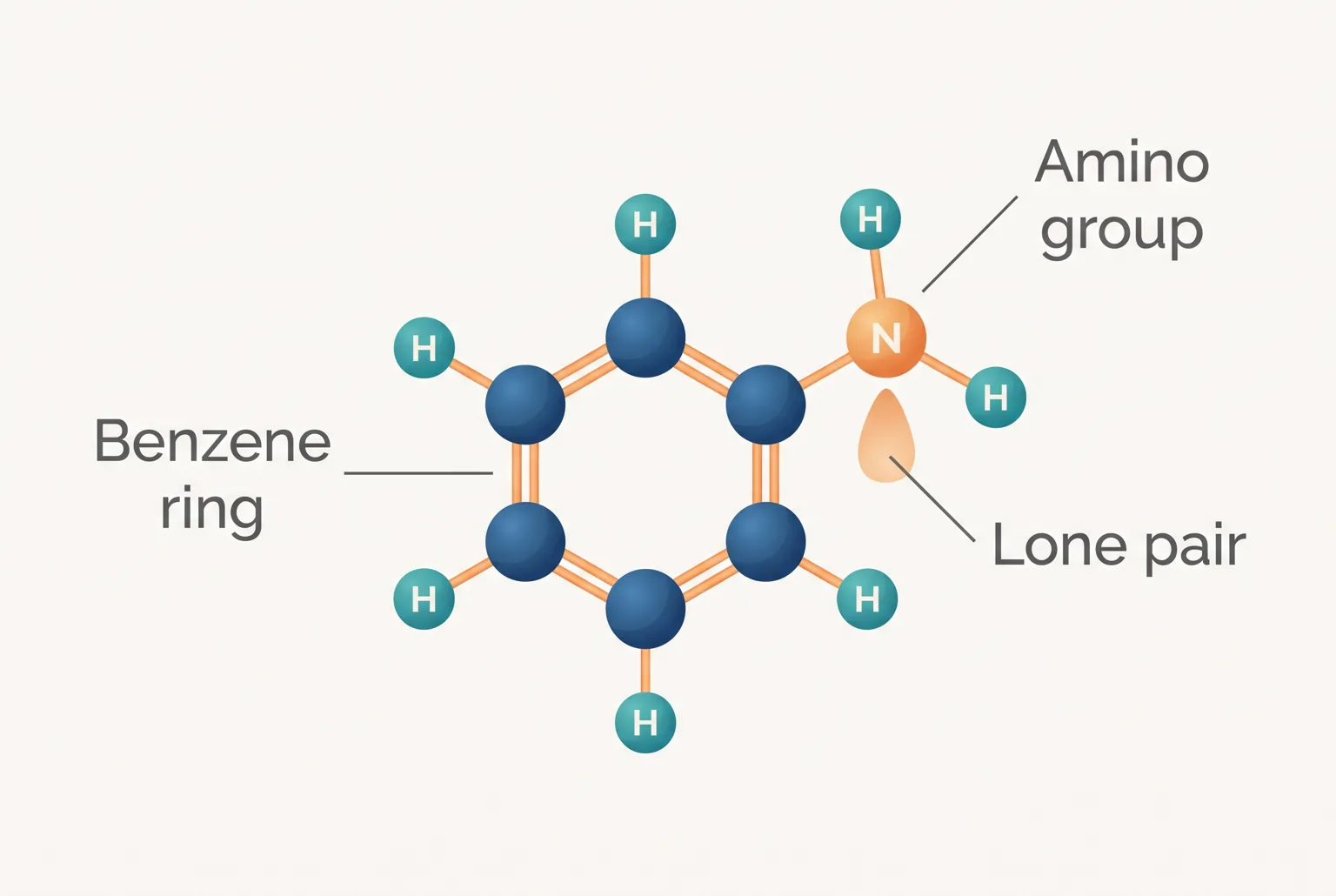
For aromatic amines, the nitrogen lone pair is delocalised into the ring, so these amines are weaker bases than ammonia. Ring substituents then adjust this:
- An electron-withdrawing nitro group lowers basicity further.
- An electron-donating methyl group raises it.
In benzylamine, the –NH₂ sits on a CH₂ group, not on the ring. Its lone pair is not delocalised, so it behaves much like an aliphatic amine.
Physical-property questions use related reasoning. The boiling points of isomeric amines depend on how many N–H hydrogens are available for intermolecular hydrogen bonding.
Choosing a preparation route by carbon count
Preparation questions often turn on how the carbon chain changes.
- Reduction of nitro compounds (for example, with hydrogen over finely divided nickel) gives aromatic amines such as aniline.
- Reduction of a nitrile or an amide with LiAlH₄ keeps every carbon. A nitrile –C≡N becomes –CH₂NH₂.
- Hofmann bromamide degradation treats an amide, R–CO–NH₂, with Br₂ and NaOH. It gives a primary amine with one carbon fewer than the amide, because the carbonyl carbon is lost.
- Ammonolysis of alkyl halides gives a mixture of amines. A large excess of ammonia favours the primary amine.
- Gabriel phthalimide synthesis gives only primary aliphatic amines. Aryl halides do not undergo nucleophilic substitution with the phthalimide anion, so aromatic primary amines cannot be made this way.
Several assertion-reason items reuse this Gabriel limitation with slightly changed wording.
Telling primary, secondary and tertiary amines apart
Identification questions ask which reagent separates two named amines, or what a test result reveals.
- Hinsberg's reagent, benzenesulphonyl chloride (), reacts differently with primary, secondary and tertiary amines. The test turns on whether a sulphonamide forms and whether it dissolves in alkali.
- The carbylamine reaction uses chloroform and ethanolic KOH. Only primary amines give it, forming a foul-smelling isocyanide.
- Nitrous acid reacts with primary aliphatic amines and releases nitrogen gas.
When a question names two amines, first classify each one. Then pick the test that only one of them responds to.
Why aniline needs a protecting group
The –NH₂ group strongly activates the ring towards electrophilic substitution and directs to the ortho and para positions. With bromine water, aniline substitutes at several positions at once.
Acetylation fixes this. It turns aniline into acetanilide, where the nitrogen lone pair is partly shared with the carbonyl group. This lowers electron density on nitrogen, so:
- the activating effect weakens and monosubstitution becomes controllable;
- acetanilide is a weaker base than aniline;
- hydrolysis afterwards restores the amino group.
Direct nitration is a separate trap. In strongly acidic conditions, some aniline is protonated to the anilinium ion, which directs to the meta position. As a result, a substantial meta product appears alongside ortho and para products.
Diazonium salts: stability, replacement and coupling
Primary aromatic amines are converted to diazonium salts with NaNO₂ and acid in the cold.
- Stability: aromatic diazonium salts are more stable than aliphatic ones because resonance with the ring spreads the positive charge.
- Replacement: the reagent decides which group replaces N₂. Copper(I) salts in Sandmeyer reactions introduce groups such as –CN or –Cl, and mild reducing conditions replace N₂ with hydrogen.
- Coupling: benzenediazonium chloride reacts with phenol in weakly basic medium to join two rings through an –N=N– azo link.
Multi-step sequences in this collection often pass through a diazonium intermediate, so track which group enters at each arrow.
Common mistakes in the assertion-reason items
The assertion-reason questions often reuse a correct statement with one word flipped. Watch for these swaps:
- Stability: "more stable" changed to "less stable".
- Resonance: credited to aliphatic rather than aromatic diazonium salts.
- Acetylation: said to increase rather than lower the activation of the amino group.
- Hydrogen bonding: credited to the wrong amine.
Judge the assertion and the reason separately first. Only then ask whether the reason actually explains the assertion.
A practice order for this collection
Use the topic finder rather than working straight through.
- Basicity: start here, because the ranking logic returns in MCQs, assertion-reason items and case-based questions.
- Preparation and distinguishing tests: practise these next.
- Diazonium chemistry and conversions: finish with these, since they combine earlier ideas.
For subjective questions, write each reagent and condition before opening View Solution. Then compare your reasoning steps with the added solution, not just your final answer.
Frequently asked questions
Is Amines Chapter 9 or Chapter 13?
The collection follows the current CBSE Class 12 Chemistry sequence, where Amines is Chapter 9. Older NCERT editions may number it Chapter 13.
Which question formats appear?
There are 72 MCQs, 34 assertion-reason questions, 54 subjective questions and 7 case-based questions. Together these make the 167 printed questions.
Are the solutions original CBSE answers?
No. The supplied material had answer-key entries and online solution links but no full written solutions. The worked solutions were added for this edition and are labelled as such.
Spotted an error? Report a correction. Practise this in the app: notes, formula sheets and mind maps.















































































































































Loading comments…