Alternating Current: Class 12 CBSE Assessment Guide and Key Ideas
CBSEPhysicsAlternating Currents
Alternating Current, Chapter 7 of Class 12 CBSE Physics, begins with a sinusoidal voltage and explains why AC is described by RMS values rather than simple averages. This guide covers reading AC equations, RMS and average values, phasors for a resistor, generator emf and power in resistive loads, then shows how the 167-question assessment is organised.
Reading an AC equation: peak, ω and initial phase
Most numericals in the first topic start from an equation such as . Before calculating anything, identify three quantities: the peak value , the angular frequency and any initial phase.
Frequency comes from . The unit of is rad s and the unit of is Hz, so do not quote as the frequency. Equations containing or correspond to supplies of about 50 Hz and 60 Hz.
An initial phase moves the timing of every maximum and zero. The quarter-period shortcut for reaching the first peak applies only to a sine wave that starts at zero. To compare two quantities with the same , compare their phase constants. The one with the larger phase leads.

Alternating Currents | Class 12 | CBSE Assessment
In the StudentCurio app
167 Class 12 Physics questions on alternating current, arranged by NCERT topic and matched to the 2025-26 CBSE syllabus, with step-by-step worked solutions. Seven topic sections (AC through a resistor and phasors; inductor; capacitor; series LCR circuit; resonance and sharpness; power and power factor; transformers), each with MCQs, 2-, 3- and 5-mark questions and a 4-mark case-based question, plus assertion-reason items.
Why AC is measured by RMS rather than average value
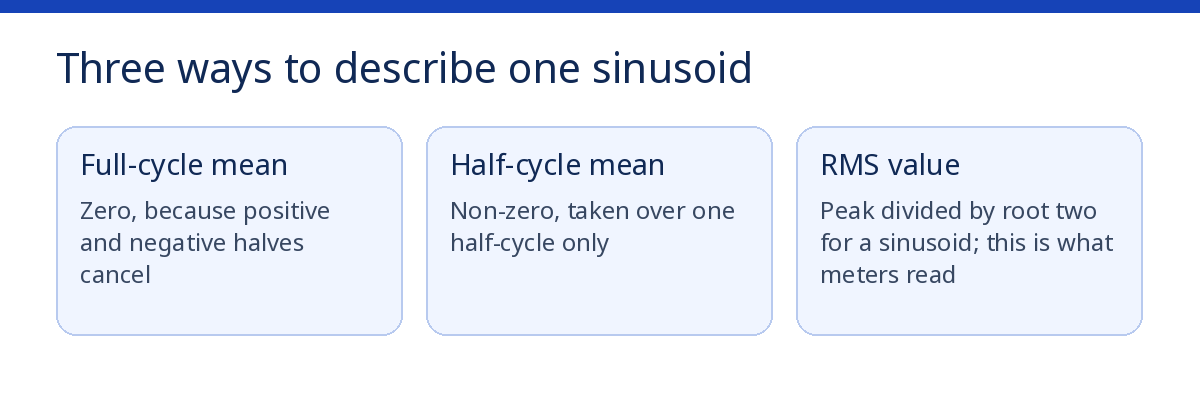
Over one complete cycle, a sinusoidal current averages to zero because the positive and negative half-cycles cancel exactly. Over a single half-cycle the average is not zero. Questions often check whether you know which interval a 'mean' refers to.
The root mean square value avoids this cancellation:
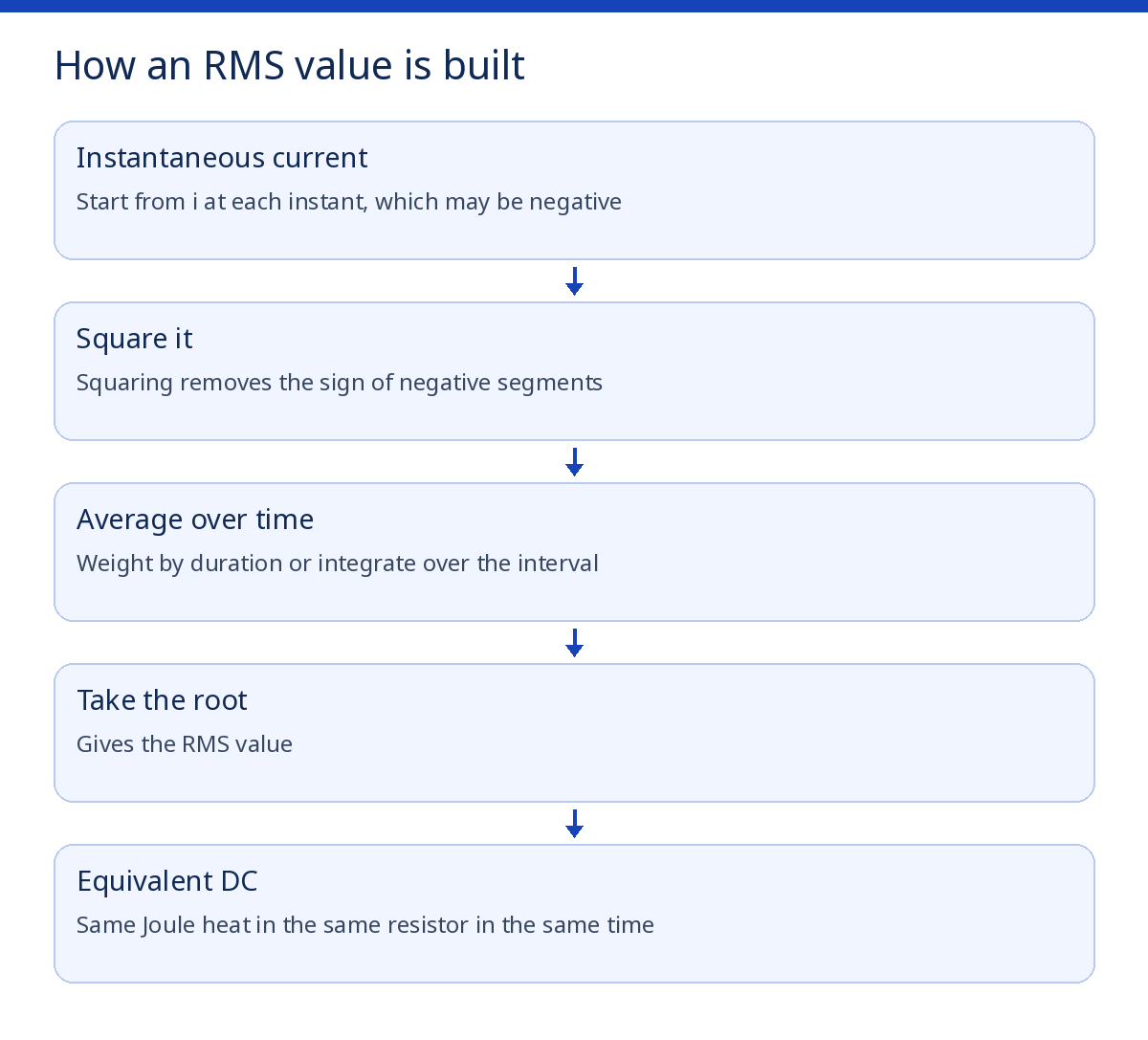
It equals the steady DC current that produces the same Joule heat in the same resistor in the same time. For , the cycle average of is . That gives .
The assessment states that AC supplies are sinusoidal and voltage ratings are RMS unless otherwise stated. AC meters are calibrated to show RMS values. A constant phase offset does not change the full-cycle RMS value.
Finding RMS for waveforms that are not pure sines
Several questions use a stepped waveform, a linearly rising current or a sum of sine and cosine terms. The relation does not apply to these. Return to the definition instead:
- Square first. Squaring removes the sign of negative segments.
- Weight by time. For a stepped waveform, multiply each squared value by how long it lasts, add the products and divide by the total interval. For a ramp, integrate over the interval.
- Take the root last.
For a current such as , expand the square. Then use the cycle averages and . The cross term drops out on averaging.
Resistor phase and the rotating phasor
In a pure resistor at every instant. The zero crossings, maxima and minima of voltage and current therefore occur together, and the phase angle is zero.
A phasor represents each quantity as a vector rotating at angle plus its phase. Its vertical projection gives the instantaneous value. For a resistor, the voltage and current phasors lie along the same line.
In graph-based items, the two curves can have different amplitudes and still be in phase. Judge phase by whether the zeros and peaks coincide, not by the heights of the curves.
Assertion–reason items here are answered in two steps. First check whether each statement is true. Then decide whether the reason actually explains the assertion.
Generator emf in the case-based question
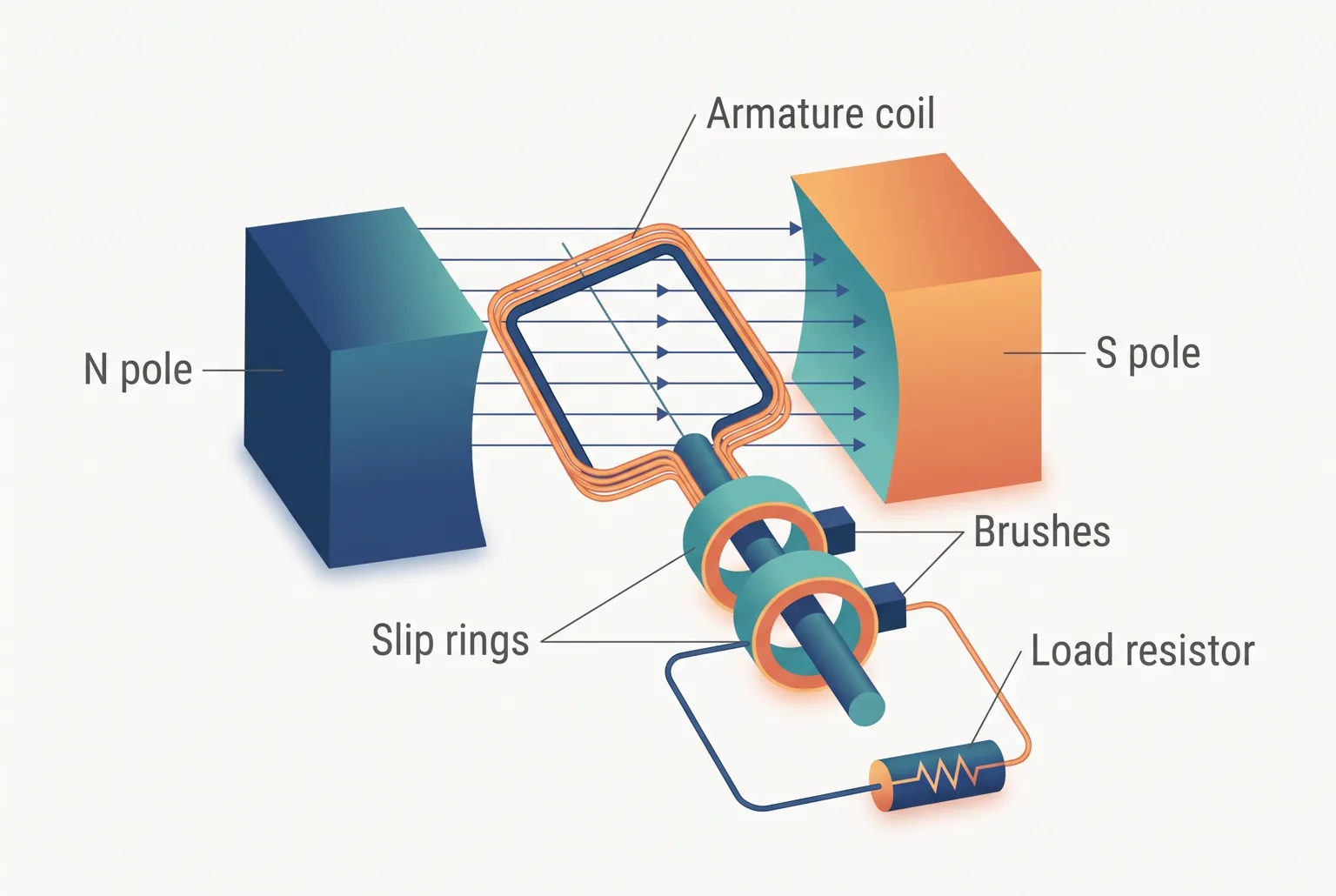
The 4-mark case-based question in Topic 1 is built on the AC generator. An armature coil rotates in a magnetic field and connects to the circuit through slip rings and brushes. You may attempt any four of the five 1-mark subparts.
The case gives the flux linkage with , so the induced emf is . The flux changes because the coil's orientation, and with it the effective area normal to , keeps changing.
The emf depends on how fast the flux changes, not on how large the flux is. Positions of maximum flux and maximum emf are therefore different points in the cycle.
For numerical parts, convert the units first:
- area in cm to m
- rev min to rad s, using (revolutions per second)
Power in resistive loads and where power factor enters
For a resistor, the average power over a cycle is , which also equals .
An appliance rating such as watts at a stated voltage is already RMS-based. No extra is needed when you find resistance or current from it.
Once loads are not purely resistive, the general form is . One solution shows that comparing two appliances by current alone fails unless their power factors are assumed equal.
The solutions also separate instantaneous power from average power. The instantaneous power can be negative while an inductor or capacitor returns stored energy to the source. For a passive load in steady state, however, the average power is not negative. Topic 1 also notes why grid power is AC: transformers can change AC voltages efficiently, the theme of Topic 7.
Common mistakes with peak, RMS and phase
- Treating a meter reading or rating as a peak value. Both are RMS unless the question says otherwise.
- Using for non-sinusoidal waveforms. Apply the mean-of-squares definition instead.
- Mixing up the full-cycle mean and the half-cycle mean. The full-cycle mean of a sinusoid is zero; the half-cycle mean is not.
- Ignoring the initial phase when timing a maximum. The shortcut works only for a sine that starts at zero.
- Thinking resistance affects timing. In a resistor, sets the size of the current, not when its peaks occur.
- Skipping unit conversions for area and rotation rate in generator questions.
Working through the seven NCERT topic sets
The assessment has 167 questions grouped by NCERT section:
- resistor and phasors (7.1–7.3, 35 questions)
- inductor (7.4, 13)
- capacitor (7.5, 16)
- series LCR (7.6, 20)
- resonance and sharpness (7.6.3, 29)
- power factor (7.7, 16)
- transformers (7.8, 38)
Within each topic, questions run from 1-mark MCQs (with assertion–reason items in most topics) to 2-mark very short answer, 3-mark short answer, a 4-mark case-based question and 5-mark long answers. Worked solutions close each topic. Question numbers restart in every section.
Work through the topics in this order, because each one builds on the previous: RMS and phasors, then the single-element circuits, then LCR, resonance and power. Attempt a full topic set before opening its solutions. Then compare your steps with the stated ones, such as conversions and the definitions you used.
Quick self-check: Can you explain, without formulas, why an AC voltmeter does not swing back and forth? Can you say when the cross term in an RMS calculation vanishes?
Frequently asked questions
Which NCERT sections does this Alternating Current assessment cover?
It covers NCERT sections 7.1 to 7.8: the resistor and phasors, inductor, capacitor, series LCR circuit, resonance and sharpness, power and power factor, and transformers.
Are voltages in the questions peak or RMS values?
The assessment states that, unless otherwise mentioned, AC supplies are sinusoidal and voltage ratings are RMS values.
Does the case-based question offer internal choice?
Yes. In the Topic 1 case-based question on the AC generator, you attempt any four subparts, each worth one mark.
Spotted an error? Report a correction. Practise this in the app: notes, formula sheets and mind maps.













































































































































































Loading comments…