Aldehydes, Ketones and Carboxylic Acids: CBSE Class 12 PYQs Guide
CBSEChemistryAldehydes and Ketones
This guide works through the CBSE Class 12 previous-year questions for Aldehydes, Ketones and Carboxylic Acids (Chapter 8). It explains nucleophilic addition, the alpha-hydrogen split between aldol and Cannizzaro reactions, distinguishing tests, acid strength and named preparations, and how to practise with the 140-question collection.
Eight tested idea groups in Chapter 8
The collection's topic finder sorts questions into eight groups:
- aldol, Cannizzaro and alpha-hydrogen reactions
- carboxylic acids, acidity and derivatives
- conversions and reaction sequences
- nomenclature and structures
- nucleophilic addition and carbonyl mechanisms
- oxidation and identification tests
- physical properties and comparative orders
- preparation methods and named reductions
One question can sit in several groups.
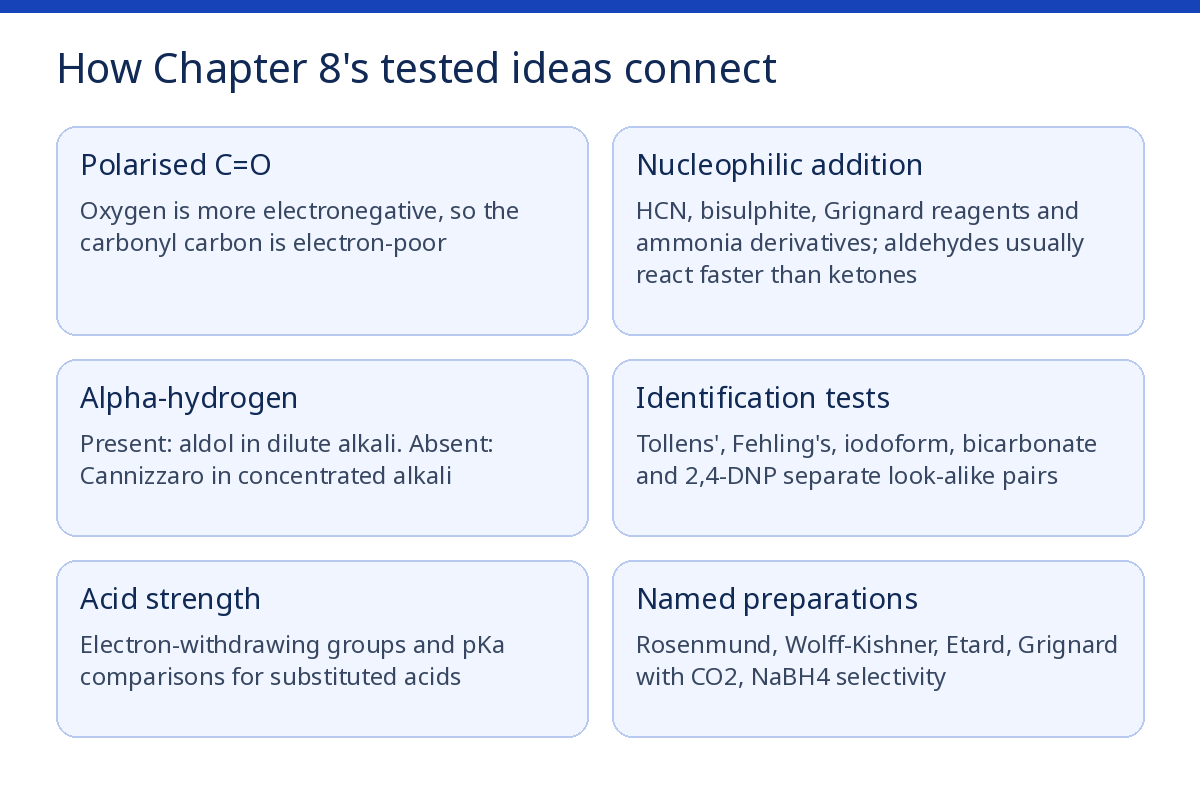
The groups are linked. Most mechanism, conversion and reactivity-order questions follow from two ideas: why the carbonyl carbon attracts nucleophiles, and why alpha-hydrogens are acidic.

Aldehydes and Ketones | Class 12 | Previous Year Paper
In the StudentCurio app
This 160-page PDF provides a comprehensive collection of solved previous year questions (2022-2024) for CBSE Class 12, focusing on mechanisms, name reactions, and chemical tests for aldehydes, ketones, and carboxylic acids.
Why the polarised C=O group invites nucleophilic addition
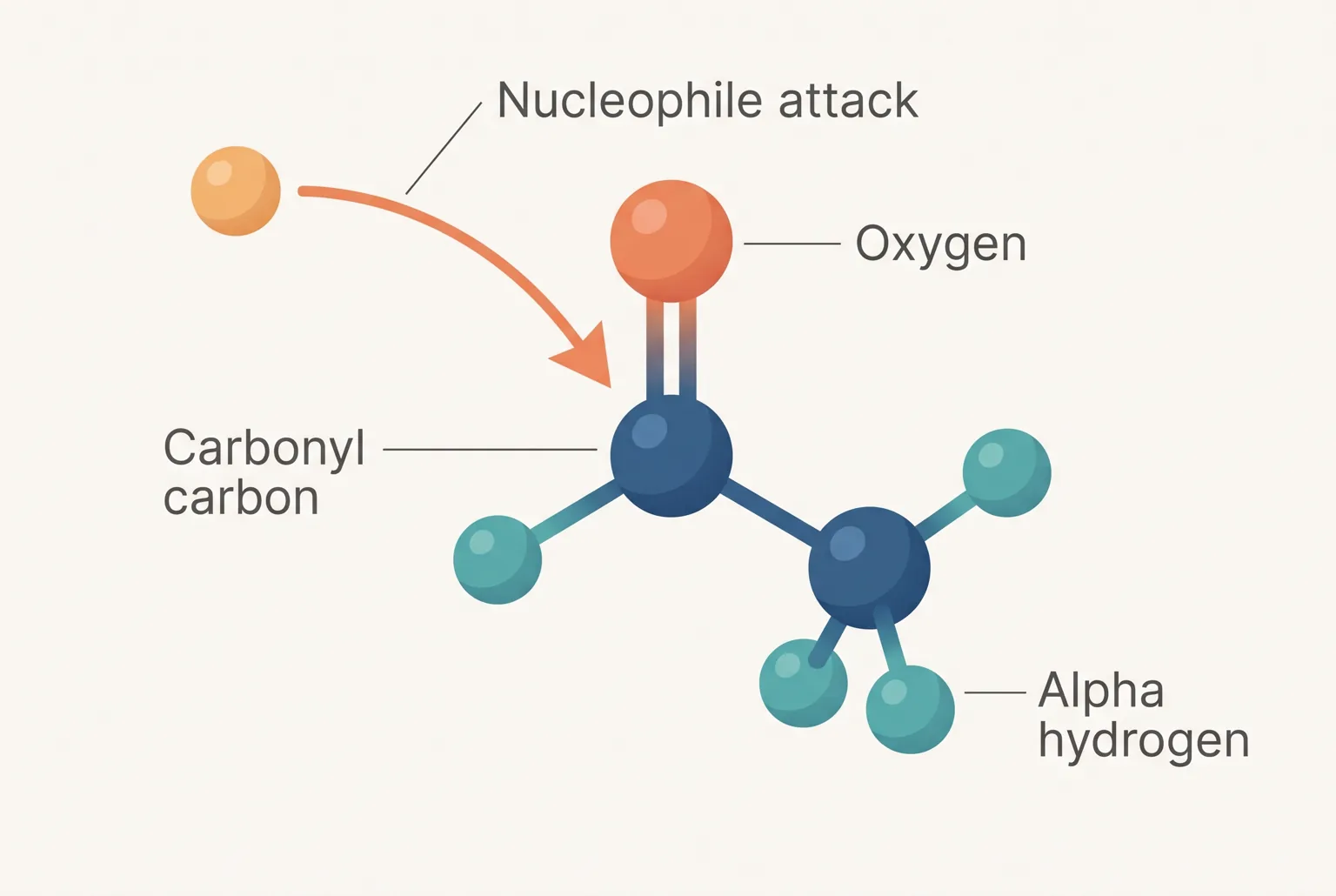
A case-based passage in the collection states the core idea. The carbon–oxygen double bond is polarised because oxygen is more electronegative than carbon. This leaves the carbonyl carbon electron-poor and open to nucleophilic attack.
Aldehydes are generally more reactive than ketones in nucleophilic addition, for steric and electronic reasons. Bulkier groups crowd the carbonyl carbon, and electron-releasing alkyl groups reduce its positive character.
Papers turn this into ranking questions. You may be asked to order methanal, ethanal and propanone, or butanone, propanone, propanal and ethanal. Justify each position with both kinds of reasoning.
The passage also lists the typical reagents: HCN, sodium bisulphite, Grignard reagents, and ammonia derivatives such as hydroxylamine, hydrazine and semicarbazide. Expect to:
- name the reaction type in cyanohydrin formation
- identify the product class formed with hydroxylamine
- draw a semicarbazone
- pick out an acetal among similar structures
- predict the alcohol class when a Grignard reagent adds to a ketone and the product is hydrolysed
The alpha-hydrogen decision: aldol or Cannizzaro
The passage gives the condition that separates these two reactions:
- Aldol: aldehydes and ketones with at least one α-hydrogen react in dilute alkali to form β-hydroxy aldehydes or β-hydroxy ketones.
- Cannizzaro: aldehydes with no α-hydrogen undergo self-oxidation and reduction in concentrated alkali.
Aldol reactivity rests on the acidic nature of α-hydrogen. One subjective question asks why that hydrogen is acidic.
Recurring patterns include:
- choosing the compound that fails to undergo aldol condensation
- deciding which branched aldehyde gives the Cannizzaro reaction
- sorting a list into aldol and Cannizzaro candidates (one stem mixes cyclohexanone, benzaldehyde, methanal and 2-methylpentanal)
For each structure, find the carbon next to C=O and count its hydrogens. Then check whether the alkali is dilute or concentrated.
One assertion–reason item asks whether the final aldol product is always α,β-unsaturated, with conjugation given as the reason. Weigh the word "always" before accepting the statement.
Picking a test that separates two look-alike compounds
Distinguishing questions recur throughout the collection. Pairs include ethanal and propanal, pentan-2-one and pentan-3-one, acetophenone and benzophenone, and propanal and propanoic acid.
The options draw on Tollens', Fehling's, iodoform (I₂ and NaOH), sodium bicarbonate, 2,4-DNP and aqueous NaHSO₃. Tests from other chapters, such as Hinsberg and Lucas, are also listed.
A reliable method:
- Find a structural feature that one compound has and the other lacks.
- Choose the test that responds to that feature.
- State the observation for both compounds.
A test that both compounds pass cannot distinguish them.
Identification puzzles stack several clues. One stem describes a C₅H₁₀O compound that forms a phenylhydrazone, gives negative Tollens' and iodoform tests, and is reduced to n-pentane. Use each clue to eliminate candidates, and record why each one is ruled out.
Reasoning about pKa and substituent effects
Acid-strength items are mostly assertion–reason pairs or "lowest pKa" choices. They cover acetic, chloroacetic, fluoroacetic and nitroacetic acids, and para-substituted benzoic acids bearing Cl, OH and NO₂.
A lower pKa means a stronger acid. Ask whether a substituent withdraws electrons (–I effect) or releases them, and how that affects the carboxylate ion.
Related items test the carboxyl group's effect on the benzene ring, such as why aromatic acids resist Friedel–Crafts reactions and where bromination of benzoic acid occurs.
In assertion–reason items, judge each statement separately. Then decide whether the reason actually explains the assertion.
Named preparations and reductions that are easily confused
Many MCQs list several named reactions as options, so you need to know what each one does. The source features:
- Rosenmund reduction, which prepares aldehydes over a catalyst
- Wolff–Kishner reduction
- the Etard reaction with CrO₂Cl₂/CS₂
- the Stephen and Reimer–Tiemann reactions
Carboxylic acid chemistry adds more:
- Grignard reagents with CO₂, followed by hydrolysis
- acetic acid with PCl₅
- soda-lime decarboxylation of sodium benzoate
- converting an acid chloride into acetone with an organometallic reagent
- halogenation with red phosphorus and Cl₂
Several items test NaBH₄ selectivity on molecules containing both a ketone and an ester, so revise which groups it reduces.
Common mistakes:
- Treating dilute and concentrated alkali as interchangeable. The source ties dilute alkali to aldol and concentrated alkali to Cannizzaro.
- Reading a higher pKa as a stronger acid.
- Using older NCERT numbering, where this chapter may be Chapter 12 rather than 8.
Working through Q1–Q140 in serial order
The PDF keeps the original serial order:
- Q1–Q42 are single-answer items: 32 MCQs and 10 assertion–reason questions.
- Q43–Q140 are 98 subjective questions, including 2 case-based items.
Each question carries year, set and region labels such as Delhi, Outside Delhi or Compartment. Marks appear only where they were printed.
The original material had answer keys but no written solutions. Every full solution here is labelled Added solution, covers each subpart and OR alternative, and opens through offline View Solution links. Apparent source errors are kept and explained.
Suggested order:
- Revise nucleophilic addition and α-hydrogen chemistry.
- Attempt the matching MCQs through the topic finder.
- Move to the assertion–reason items.
- Finish with timed subjective and case-based questions.
Compare each attempt with the added solution, looking for missing steps and not just the final answer.
Quick self-check: can you explain, without notes, why aldehydes usually react faster than ketones in nucleophilic addition?
Frequently asked questions
Does this collection follow current CBSE chapter numbering?
Yes. It uses Chapter 8 from the current CBSE Class 12 Chemistry sequence and notes that older NCERT editions may number the chapter as 12.
Which question formats are included?
Q1–Q42 are single-answer items (32 MCQs and 10 assertion–reason). Q43–Q140 are 98 subjective questions, 2 of which are case-based.
Are the worked solutions official CBSE answers?
No. The source states that all full solutions were added for this edition and are labelled as Added solutions.
Spotted an error? Report a correction. Practise this in the app: notes, formula sheets and mind maps.















































































































































Loading comments…